
 Michigan State Spartans
Spartan Tailgate
Michigan State Spartans
Spartan Tailgate
Five First Downs and Eighteen For Loss: What Michigan State’s Defense Did After Grambling’s Opening Drive
The first-drive problem was a loaded line and an empty second level, and the correction took one series. Three fronts against an option team. A walk-on starting over Cam Stodghill. Rustin Young’s afternoon at center, Derrick Simmons getting displaced, Charles Brantley’s two reps, and what carries over to Eastern Michigan.
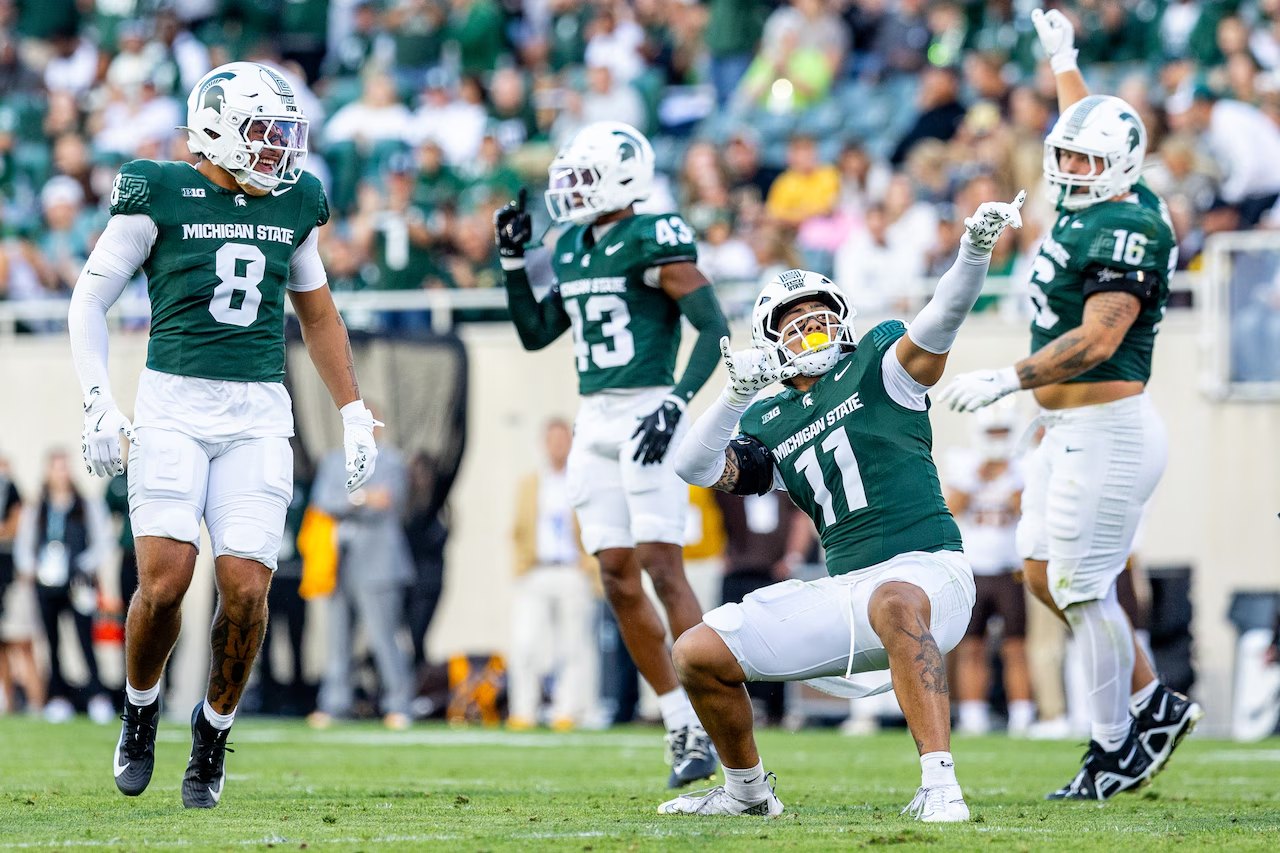
Michigan State beat Grambling State 56-7 on Saturday at Spartan Stadium. The Spartans are 1-0.
The final margin is the least useful number in the box score. Two others are worth more.
Grambling finished with five first downs. All five came on the opening possession.
Michigan State finished with eighteen tackles for loss.
Everything else Saturday produced is either downstream of those two facts or is a function of playing an FCS opponent, and this page will try to keep the two categories separate.
- Result
- Michigan State 56, Grambling State 7 (7-14-14-21 / 7-0-0-0)
- Total yards
- MSU 618 on 9.4 per play · GSU 147
- First downs
- MSU 31 · GSU 5, all on the opening drive
- Third down
- MSU 7-of-10 · GSU 1-of-10
- Yards per pass
- MSU 12.5 · GSU 3.3
- Negatives
- MSU 18 TFL, 1 sack · 0 sacks allowed, 1 penalty (hold), 0 turnovers
- Punts
- MSU 1 (52 yards) · GSU 7
- Next
- Eastern Michigan (1-1), noon Saturday, Spartan Stadium
The opening possession, and what was actually wrong
Grambling ran the option eleven times in the first quarter and got nowhere with it three consecutive times on that first drive.
The Spartans were sound on the play itself. The dive key was covered, the quarterback was accounted for, the pitch was covered.
What beat them was the answer to it. Two misdirection runs back to the fullback, cutting against the flow the defense had already committed to. The second one went 30 yards for a touchdown.
The structural cause is straightforward and it is the oldest trade in defending this offense.
Michigan State loaded the line of scrimmage. Extra bodies down, safeties tightened, everybody within a few yards of the football. That is a rational way to take away the dive and the quarterback keep, and it works.
It also empties the second level. If nine defenders are attacking the mesh, the space behind them belongs to whoever gets there, and misdirection is the play designed to send a fullback into exactly that space.
Grambling did not invent that answer for Michigan State. Every team that runs this offense has that counter, and it is on tape.
Michigan State ran it twice against them and it went for 30 and a touchdown once, and for a chunk the other time.
Grambling scored on that drive. The score was 7-7 with a little over four minutes left in the first quarter.
The other first-quarter problem
Michigan State’s opening sequence on offense was not what eight months of preview material predicted either.
The Spartans came out throwing. The second real snap of the season was a 43-yard shot to Braylon Collier. The next play was a 17-yard Cam Edwards touchdown run.
Eighty seconds, 7-0, and the call sheet had already established that this offense is not going to be a ball-control operation.
Then Grambling scored, and Michigan State got the ball back at its own end and threw it three times.
Three straight dropbacks, backed up, with a redshirt freshman making his first start, immediately after the crowd had just gotten quiet. Three-and-out.
That is a play-calling error with an obvious diagnosis: the deep shot worked, so the next series went looking for another one.
Michigan State did not repeat it. The next possession opened with three consecutive runs and Edwards carried on two of them.
Michigan State scored eight touchdowns in the game. Seven of them came after that possession, which produced the only punt the Spartans attempted all afternoon.
The correction
The fix was visible on the second possession and it did not require a scheme change.
Michigan State stopped sending everyone to the football and left a defender in the alley. One body, held back, responsible for the cutback and nothing else.
That is the cost side of the trade. Keeping a defender out of the fit means the dive is slightly less well-defended and the quarterback keep gets an extra half-step.
Grambling ran the same misdirection twice more before halftime. The two carries gained one yard combined.
Grambling did not gain a first down for the remaining three quarters.
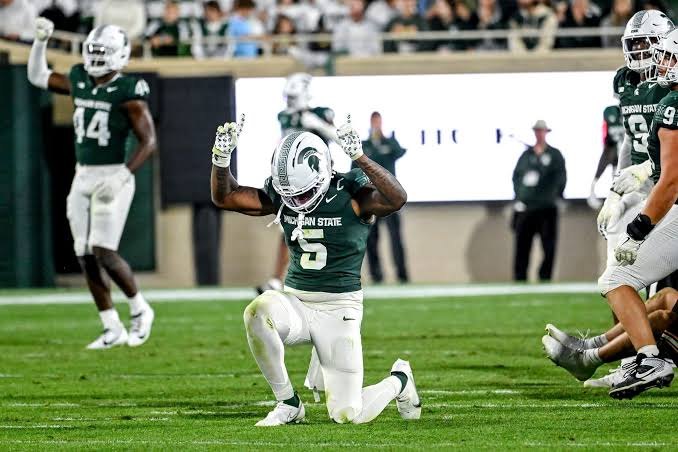
The correction was not clever. It is the standard adjustment, available in any defensive playbook in the sport.
What matters is that it was made inside one series, in the first game a first-year staff has ever coached, by a head coach who is also calling the offense.
Michigan State has recent history of corrections arriving in the third quarter or not at all.
“They ran a good play and we were in a bad look for it. Then they ran it again and we were still in a bad look for it, so we got out of the look. That’s all that was. I know it isn’t much of an answer, but that’s all that was.” — Joe Rossi, defensive coordinator
Rossi’s point is accurate and it is also the reason the sequence is worth documenting. The problem was identified and the trade was made.
Grambling’s offense had one more idea in it after that, which was to throw. It attempted very few passes and completed two.
Three fronts, not one
For eight months this defense has been described in one number: 4-2-5. Four down, two linebackers, five defensive backs. Lighter than the conference standard. Built on speed.
Michigan State did not play much of it Saturday.
Against a run-first option offense the Spartans played a three-man front with four linebackers, a conventional four-man front with three, and a five-man front with two in short yardage and near the goal line.
Personnel groupings changed by series. On at least four occasions they changed inside a series.
Each of the three has a specific reason to exist against this offense.
The odd front puts a nose on the center, which is the cheapest way to keep an option team from getting a free release to a linebacker. It also gets four linebackers on the field, which matters against a team that wants to make everybody tackle in space.
The four-man front is the base look and was mostly used once Grambling was behind and had to consider throwing.
The five-man front appeared in short yardage. Two linebackers, five down, nobody getting displaced on a dive. Grambling did not convert a short-yardage run after the first quarter.
None of that is exotic. Multiple fronts are ordinary at this level.
What was not expected is that a staff installing its first defense, with a coordinator whose reputation is for conventional structure, would carry three of them into game one and rotate them by series.
Two staffers have said since Saturday that the multiplicity was built for this opponent specifically. That is a caution against reading it as an identity.
“We had three fronts up for that game and we ended up using all three, which is more than you’d normally carry into an opener. That isn’t us being clever, that’s what that offense does to you. You sit in one thing all day against an option team and they’ll have it figured out by the second quarter and then you’re just watching.” — Joe Rossi, defensive coordinator
Nick Mansour, who calls the defense in game and did not build it, was asked about the multiplicity and gave the credit away before the question finished.
“Joe built that. I’d like to take some of it and I can’t, it isn’t mine. We had three fronts because he wanted three fronts. The part I’d actually point at isn’t the fronts, it’s that he had it fixed after a series and a half. That’s fast. I’ve watched a lot of tape of teams taking a half to do that.” — Nick Mansour, head coach
The 4-2-5 has still not played a meaningful snap.
Piwowarczyk over Stodghill
The most consequential personnel decision of the week was made on Wednesday and nobody outside the building knew about it until the first defensive series.
Chris Piwowarczyk started at linebacker. Cam Stodghill did not.
Piwowarczyk is a walk-on. He is shorter, thicker and stronger than Stodghill, who is the lighter and quicker of the two and the one who fits the advertised defense better.
That is the entire reasoning, and it is good reasoning.
An option offense wins at the second level by displacing linebackers laterally. The blocking scheme is built to wash a linebacker down inside and then run behind him. Height and length are liabilities in that fight. Leverage is the whole job.
Piwowarczyk plays under people. He finished with four tackles and two tackles for loss in the first start of his career.
He also did the unglamorous part of it, which does not appear anywhere in a box score: he took on the lead blocker and did not get moved, which is what allowed the linebacker next to him to run free.
Brady Pretzlaff had three tackles for loss. Jordan Hall had two and eight tackles.
The Stodghill side of this is worth stating plainly. He was not benched for performance. He was swapped for a body type for one opponent.
“I’m not tall. That’s the whole reason I was out there and everybody in that room knew it before I did. They want to wash you down and run behind you. It’s easier to get underneath somebody when you’re already down there.” — Chris Piwowarczyk, linebacker
Eastern Michigan does not run the option. Expect the depth chart to look different this week.
Eighteen for loss
Eighteen tackles for loss is a large number in any game. It is a very large number against an offense that is designed to prevent them.
An option team does not hand the ball off deep in the backfield. The mesh happens at or in front of the line. The pitch happens on the perimeter. The whole structure is built to get downhill before a defender can meet the ball behind the sticks.
Producing eighteen negative plays against that offense requires defenders to arrive at a specific spot before the ball does, repeatedly, for three quarters.
The distribution matters as much as the total. Pretzlaff three. Hall two. Piwowarczyk two. Andrew Brinson IV one from corner. Nikai Martinez nine tackles from strong safety, several of them at or near the line.
Michigan State recorded one sack, by Dejae White, in the fourth quarter against backups. That is not a criticism. Grambling attempted very few passes.
Michael Richard had two pass breakups. Brinson had two.
Grambling gained 147 yards on the afternoon. Roughly half of that came on the opening drive.
Young at center
The loudest argument of the preseason produced one of the quietest results of the game.
Rustin Young is a 6-foot-7 offensive tackle who started at center. The listed concerns were pad level against a nose, snap mechanics while making line calls, movement in short yardage from a high stance, and whether the identification calls should be coming from a player learning the position.
Three of the four did not surface. There was no bad snap. There was no penalty on the interior. There was no visible confusion on a line call, and Michigan State did not burn a timeout for a procedural problem all afternoon.
The fourth one surfaced early and then stopped.
Young was beaten on reach blocks twice in the first quarter, both times by a defensive lineman aligned to his play-side shoulder who got there first. Both were leverage losses. That is the exact failure mode the argument predicted.
After that he was mostly good, and in one specific area he was clearly better than a conventional center would have been. Getting to the second level and finding a linebacker in space is the hardest thing a center does, and Young is the best athlete on that line. He made those blocks. Two of Cam Edwards’s longer runs had Young out in front of them.
The short-yardage question did not get a clean answer. Michigan State failed on three consecutive runs from inside the four in the second quarter, and two of those were quarterback sneaks that got no push. That is a center-and-guard problem by definition.
The counter-argument is that Grambling’s interior front is not a Big Ten interior front, and it is a fair counter-argument.
Young was up and down in the run game and mostly up. That is the honest grade and it does not settle the argument in either direction.
“It was fine. I snapped it and they got it. Got beat on a couple of reaches early and then I stopped getting beat. Second half was better than the first half. I don’t really have more than that.” — Rustin Young, center
Notre Dame is two weeks away.
Derrick Simmons got moved
The clearest individual problem on Saturday was at defensive tackle.
Derrick Simmons is a sophomore who played edge last season and converted inside this offseason. He is on the lighter side for the position and he still carries an edge rusher’s frame.
On the opening drive he was displaced off the football repeatedly. Not beaten with technique. Moved.
That is a direct cause of what happened on that drive. When the nose or the three-technique gets driven two yards off the ball, the linebacker behind him loses his read and the crease behind the second level widens. Both misdirection runs went through space that a defensive tackle holding his ground would have narrowed.
Simmons was not the only reason. He was the largest single one.
He was better after the correction, in part because he was asked to do a different job. In the odd front he was playing over a guard rather than head-up on a center, which is a more forgiving assignment for a lighter body.
This is a weight-room problem with a schedule attached to it. It does not get fixed by Saturday and it does not need to be. Eastern Michigan is not going to try to displace him for four quarters.
Big Ten interior lines will.
Charles Brantley’s two reps
Grambling completed two passes in the game.
Both were thrown at Charles Brantley. Both were caught. Both came on third down and both were the only meaningful throws the Tigers made all day.
Neither was a coverage bust. Brantley was in position on both. He was beaten physically, in a contested-catch situation, by a receiver who put a body on him and went and got the football.
That is not the way Brantley usually loses, and he has been better than that consistently over his career. It is two reps.
Grambling did not throw at him again after the first quarter, which is a statement about how the rest of the game went and not about Brantley.
The reason it goes in this column rather than getting waved off is the schedule. There is nothing Grambling put on the field that resembles the receivers on the next three opponents’ rosters, and losing contested balls compounds against better ones.
Two reps in one game against an FCS opponent do not constitute a trend. They go in the file and they stay there until something else does or does not join them.
Fourth and goal from the two
Ten seconds left in the first half. Michigan State ahead 21-7. Fourth and goal at the two, after three consecutive failed runs from inside the four.
The three runs were an H-back dive with Jayden Savoury and two quarterback sneaks. Cam Edwards did not touch the ball on any of them.
Mansour called a pass. Crishon McCray made a contested catch in the back of the end zone. The officials ruled the ball moved when he hit the ground. No catch, turnover on downs, half over.
The crowd reaction was the loudest sustained thing that happened in the stadium. It lasted about four minutes and it changed nothing about the game.
The football notes are two, and neither is about the officiating.
First: three runs from inside the four without the best player on the roster carrying the ball is a real decision and it did not work. Two of the three were sneaks that got no push, which puts it back on the center and the guards. The interior did not move anybody.
Second: the fourth-down call was correct. A team that has just been stopped three times running has no reason to believe the fourth one goes differently, and the defense had committed to the run on all three. The throw was open. It was caught.
Michigan State led by 42 at the end of the third quarter. The sequence cost nothing except a point total.
How the offense got to 618
Michigan State ran 66 plays and averaged 9.4 yards on them, which is the sort of number that usually indicates two or three long plays doing all the work.
That is not what happened. The distribution was broad.
The longest run of the day was 33 yards. The longest pass was 43. Neither is a freak play.
What produced the yardage was yards after the catch and a run game that did not have negative plays in it. Brennan Paracheck had 40 of his 56 receiving yards after contact or after the catch. Rowan Merlino’s one reception was a five-yard drag that went 54. Crishon McCray’s two touchdowns were both short throws.
KK Smith was the most-used receiver in the game and the most interesting one. Seven catches for 105 yards, plus 30 rushing yards on jet motion, which means the staff was using him as a movement piece and not just a route runner.
He had the offense’s only drop.
Braylon Collier had four for 66. Fredrick Moore was the fifth receiver and was not a factor.
Jayden Savoury, the redshirt freshman H-back, was on the field as a blocker far more than as a receiving threat, and the one time he got the ball in a critical spot he did not get in. That is a normal first game for a 19-year-old move piece.
Brandon Tullis ran five times for 32 yards and scored twice, both from short range. Jaziun Patterson, Bryson Williams and Zion Gist got fourth-quarter work.
Michigan State converted 7 of 10 third downs. The three failures came in the first quarter.
Special teams
Crishon McCray returned five punts for 78 yards, an average of 15.6, which is a very good day and reflects a blocking unit that got its assignments right on a Saturday when a first-year staff had every reason to have one of those units go wrong.
Liam Boyd made all eight extra points. He did not attempt a field goal, because Michigan State never needed one.
Rhys Dakin punted once, for 52 yards.
No blocked kicks. No muffed returns. No kickoffs out of bounds. No penalties on any coverage unit.
Special teams disasters are the specific way a heavy favorite has a bad afternoon, and Michigan State has recent institutional memory of that. It did not happen.
The rest of the offensive line
Michigan State did not allow a sack and was flagged once, for holding.
Ben Murawski was the best lineman on the field. Rock solid in pass protection, sealed the edge on both of Edwards’s longest runs, and got to the second level cleanly more than once.
Nick Sharpe mauled people at left guard, at the line and past it. He allowed one pressure.
Conner Moore was solid in both phases at right tackle and did not have a bad rep worth writing down.
Luka Vincic was the weak spot. He gave up several pressures at right guard. None of them turned into a sack and none of them were disasters, and he did his job on most snaps without doing more than that.
Against Grambling that is fine. It is also the position on this line with the least margin, and the interior of this offensive line remains the group the program trusts least.
The run numbers say the line worked. Michigan State averaged well over nine yards per play and Edwards averaged 9.1 per carry.
Grambling is the reason not to make much of it.
- Hannan 19-23, 250, 2 TD, 0 INT
- Hannan 6 carries, 24 yards
- Milivojevic 4-5, 100, 2 TD
- Edwards 16-147, 9.1 avg, 2 TD, long 33
- Tullis 5-32, 2 TD
- KK Smith 7-105 (+30 rush)
- Collier 4-66, long 43
- McCray 5-45, 2 TD
- Paracheck 4-56 (40 YAC)
- Merlino 1-54, TD
- Whiting 1-18, TD
- 0 sacks allowed
- 1 penalty (hold)
- Murawski, Sharpe best grades
- Martinez 9
- Hall 8 (2 TFL)
- Pretzlaff 7 (3 TFL)
- Piwowarczyk 4 (2 TFL)
- Brinson IV 2 PD, 1 TFL
- Richard 2 PD
- White 1 sack (fourth quarter)
- McCray 5 PR, 78 yards
- Boyd 8-of-8 PAT, 0 FGA
- Dakin 1 punt, 52 yards
The quarterback
Leo Hannan completed 19 of 23 for 250 yards and two touchdowns in his first career start. He added six carries for 24 yards and did not turn the ball over. He was not sacked.
The completion percentage is 82. The more useful number is 12.5 yards per attempt, which is a deep figure for a game with only 23 throws in it.
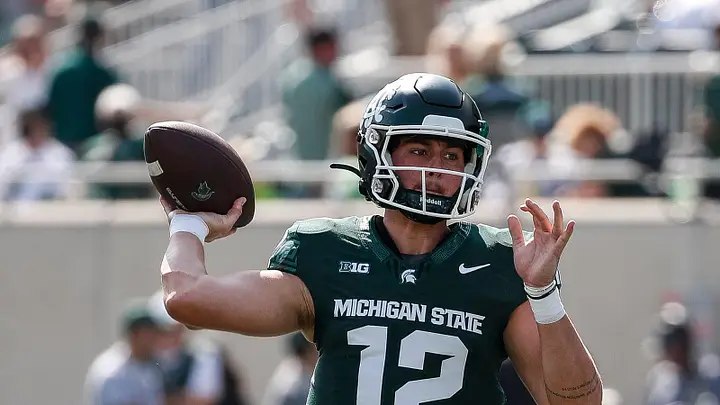
He threw one true shot and hit it, a 43-yard ball to Braylon Collier on the second possession of his career, placed away from a corner playing a vertical cushion. He did not force a second one.
The rest of the afternoon was short and intermediate, on time, into the middle of coverage that was mostly vacated because Grambling was concerned about the run.
Four of his six carries were first downs. None were designed. All were the result of a pocket that held and nobody being open, which is the correct decision tree for a redshirt freshman and is also the hardest one to coach.
Three qualifications belong here.
He was throwing against an FCS secondary that was playing to stop Cam Edwards. He was not asked to make a full-field read more than a handful of times. And he was never behind, never hurried by score, and never had to play a fourth quarter.
Second start comes Saturday against a MAC defense with a fifth-year captain at linebacker and a graduate captain at safety.
The fourth quarter
Alessio Milivojevic played the fourth quarter against Grambling’s backups and completed 4 of 5 for 100 yards and two touchdowns.
Both scores are worth describing accurately. The first was a five-yard drag route to Rowan Merlino with no defender within ten yards, and Merlino ran it 54 yards. The second was an 18-yard ball to Eddie Whiting that was a good throw.
The Michigan State sideline emptied for him on both.
It does not reopen the quarterback job. Hannan went 19-of-23 in the same game.
What it does is confirm that the backup quarterback can operate the offense, which is not a small thing for a program with one healthy scholarship arm behind him.
Eastern Michigan
Eastern Michigan is 1-1. The Eagles beat Sacramento State and lost to San Jose State. Kickoff is noon Saturday at Spartan Stadium.
Chris Creighton has been the head coach there since 2014. He inherited a program that had not been to a bowl game in more than two decades and took it to several. He is one of the more respected head coaches in the country in the actual profession and he is not a novelty in any direction.
The Eagles will not run the option. Everything Michigan State built for Saturday, the three fronts, the body-type swap at linebacker, the alley player, was built for a specific offense that is not on the schedule again.
Expect the base defense back. Expect Stodghill.
Their quarterback is Noah Kim, a seventh-year graduate student on an NCAA waiver. He started at quarterback for Michigan State in 2023.
That matters, and other people will write about what it means. The football version is narrow: Michigan State is playing a quarterback with more college starts than anyone on its own roster has, at any position, and seventh-year quarterbacks do not get confused by disguise.
The Eagles carry a veteran defense. Makhi Gilbert is a senior captain on the defensive line. Zach Mowchan is a graduate captain at linebacker. Bryce Llewellyn is a graduate captain in the secondary. That is three captains in their fifth or sixth year of college football on a defense Michigan State will see at noon.
Their skill group has Michigan in it. Running backs Joey Mattord and XaVior Tyus are from Hartland and Portage. Receiver Quinn Fracassi is from Howell. Defensive back Jason Marshall is from Trenton.
Those are in-state players Michigan State did not sign, which happens to every program in every state.
“They’ve played two games and they look the same in both of them, the win and the loss. That’s usually what it looks like when somebody’s been running the same thing for a long time and everybody knows what they’re doing. I don’t have a big insight for you on it. Most of our week is on us anyway.” — Nick Mansour, on Eastern Michigan
Five things this week’s tape asks
1. Does the base defense look like the advertised one. Michigan State has not played a snap of the structure it spent eight months describing. Eastern Michigan is a conventional offense and there is no reason to carry three fronts against it. If the 4-2-5 does not show up Saturday, it is fair to start asking whether it exists.
2. Whether Stodghill is back in. Piwowarczyk started for a body-type reason that no longer applies. If the walk-on stays on the field against a non-option offense, that is a much bigger statement than last week’s start was.
3. Simmons against a base run game. The problem last week was displacement. Eastern Michigan will run inside zone and power at a defensive tackle who is still built like an edge, which is the same test with less riding on it.
4. Whether Hannan gets asked to do more. Twenty-three attempts, one deep shot, mostly half-field reads. A second start against a veteran defense is the first reasonable place to see the rest of the menu.
5. Short yardage. Michigan State ran three times from inside the four in the second quarter and did not score. Two of those were sneaks. That is the interior of the offensive line and it is the one thing on this roster nobody has been able to talk themselves into.
What Saturday established
The list of things Michigan State proved on Saturday is short.
It proved that the machinery works. One penalty, zero sacks allowed, no procedural timeouts, no bad snaps from a converted tackle, a correction made inside one series, a play sheet that got calls in on time for four quarters.
Those are operational facts and they hold regardless of opponent.
It did not prove anything about talent. A Big Ten roster gaining 618 yards on an FCS defense is the expected outcome, and the same score would have been produced by most of the teams in this conference.
It did not prove anything about the defensive identity, because the defense that played on Saturday was built for one opponent and will be dismantled this week.
It did not settle Rustin Young, Derrick Simmons, the interior of the offensive line or Charles Brantley.
Michigan State is 1-0, 0-0 in the Big Ten. No injuries, suspensions or role changes were reported. Eastern Michigan visits at noon Saturday on Big Ten Network.