The argument about Nick Mansour has run since the day he was hired and it has mostly been one argument: whether a man who never played a down of football can know any. Radio has it. Rival boards have it. Half of Michigan State’s own fanbase has it in a group chat most nights.
There is a second question underneath it, and it is a genuinely different question. Knowing football and operating a football game are separate skills. Plenty of people who are excellent at the first one have been visibly, expensively bad at the second.
On Saturday afternoon Mansour stands inside a six-foot white border with roughly sixty other people, on a headset wired into a system he has never used in a live stadium. He is responsible for a play clock that runs whether or not he has finished thinking, a substitution process he is not permitted to execute himself, an officiating crew that has never met him, and one radio channel into the helmet of a nineteen-year-old making his first career start. He calls the offense. He calls the defense.
Nobody in East Lansing has any evidence about how that goes. He has not run one.
So he spent part of a week that a normal staff spends on an option offense doing something else. Michigan State permitted four sessions of access on one condition: no play call, no formation, no signal. None of that appears here. Everything else does, including an offensive line coach in his thirty-first year who thinks the whole exercise cost him an hour and forty minutes he badly needed.
The document
It arrived in the staff room Monday morning in a stack, still warm. Twenty-two pages, eleven sections, spiral bound. Two lines on the cover. First: GAME OPERATION — WK1. Second, at the bottom in smaller type: None of this is football.
Inside: headset assignments. A taped map of the team area with names on yard lines. A page about the officiating crew that is mostly a list of things not to do. A page called “Ninety Seconds.” A page of clock scenarios that gets worse the further down it you read. A fourth-down chart with one row marked disputed. A personnel page for a defense that does not intend to substitute. And page fourteen, which is a list of things that are embarrassing to have written down and which gets its own section later.
Section four is one word long. Section four is the word “Dell.”
Dell Wysocki is forty-seven and has run strength rooms since Mansour was in middle school. He asked what section four meant and was told, “You’ll know.”
The first read-through took an hour and forty minutes and was, by broad agreement, not thrilling. Three people were on their phones by the time the room reached the officiating page. Mansour got to the third bullet on it, looked up, and said he had lost everybody. A defensive assistant told him he had lost everybody on the first bullet. He said that was fair and kept going anyway.
Sal Brancato has coached offensive lines for thirty-one years. He read four pages, put them face down, and waited for a gap in the conversation.
I’ve got an interior that can’t pass off a twist yet. That’s the actual thing that’s wrong with us. And we’re going to spend an hour and forty minutes on where people stand if there’s lightning. I’ve been getting plays into a huddle since before he could drive a car. There’s a version of this where you’re rehearsing the part that isn’t broken.
Mansour agreed with the first half of it out loud, twice, and then ended the conversation without winning it.
You’re right that you’re not the variable. You’ve done three hundred of these. Nobody in this room is the reason this goes sideways Saturday, I am. So we’re not rehearsing you, we’re rehearsing me, in front of you, because you’ll tell me when it’s wrong.
Brancato’s response, verbatim: “Fine.” Not a conversion. He spent the rest of the week keeping score out loud, and nobody asked him to stop.
Channel one, channel two
Since 2024 a college team has been allowed to put a coach’s voice into one helmet on each side of the ball. One. If that player leaves the field, the voice goes with him. There is no exception written for a head coach who calls both.
For most programs that is a convenience. Michigan State has a head coach who calls both units, so two helmets on this roster need the same voice. His answer is a routing rule.
“It’s worse to have two voices in a kid’s ear than one voice that’s a little bit late. So we’ll be a little bit late. I’m fine with that.”
On offense his voice goes to Leo Hannan, direct. On defense it does not reach the field at all. He gives the call to Joe Rossi standing next to him, and Rossi says it into Jordan Hall’s helmet. Every snap, including the snaps where the other way is faster.
His argument was that the defense has been hearing my voice since January, and the week you put a new voice in a kid’s ear is not the week he plays a team that snaps it in nine seconds. That’s correct. I also think he’s giving away a half-second he’ll want back in November.
One law governs it, five words in the document and said out loud something like forty times over four days: one voice per unit. If two people are talking on a channel, both are wrong, regardless of which one is right.
Three channels are live Saturday. Two carry play calls. The third is the training staff and carries no football at all.
The defensive helmet was not always Hall’s. In the first draft it went to Tre Bell, the nickel who does not come off the field and has to set the picture when an offense shifts, which made him the obvious choice to Mansour. Rossi wanted Hall: more experience, more volume, and the fact that Hall has actually done the job. Rossi won it in about a minute.
I still think it’s Tre. I’ll probably still think it’s Tre in October. But Joe’s done this a couple hundred times and I’ve done it zero times, and I don’t have a good answer to that, so we’re doing it his way. I asked if we could look at it again after Nebraska. He said fine. He did not mean fine.
Nick Sheridan is in the box Saturday and did not want to be. He argued for the field, on the grounds that a redshirt freshman should be able to find his coordinator with his eyes. Mansour said no twice. The second reason was the one that moved him: if you’re standing next to Leo, Leo has two coaches. Sheridan is still not certain it was right, and said so on Thursday without being asked.
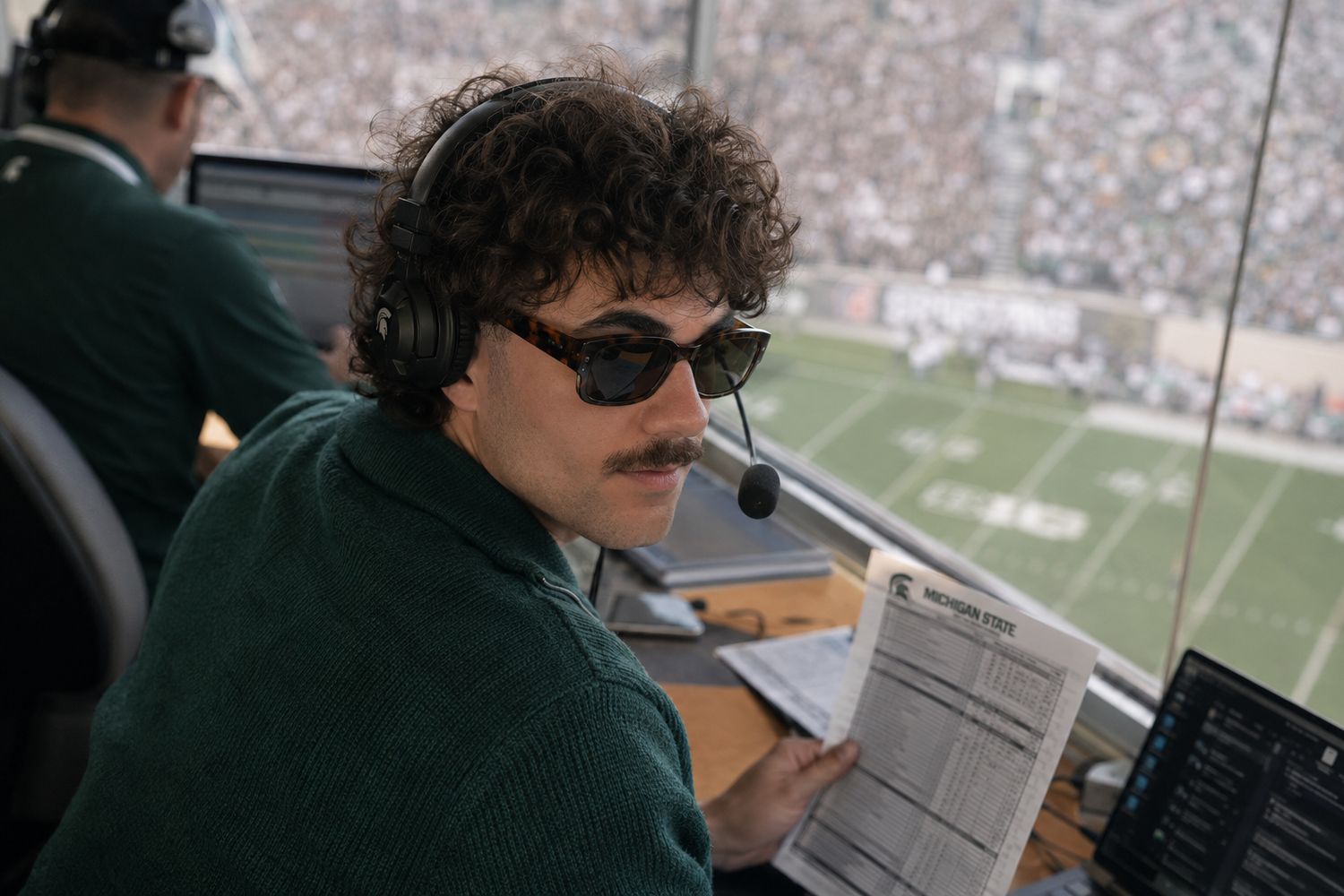
The acoustics problem
Grambling State is bringing a band. It is better known nationally than the football team. It will be at one end of a stadium that is not going to be full. Nobody else on the staff had that written down anywhere. Mansour had it on page nine.
Sideline communication plans are built for a crowd, which is undifferentiated noise from above and behind, no pitch, no rhythm, and you can talk straight through it. A horn line does not behave like that. It is loud in specific frequencies, it stops and starts, and in a half-empty stadium it comes off the far stands and lands on top of a human voice.
“A crowd you can just talk through. A band, you sort of have to talk in the gaps. It’s a different problem and it isn’t on anybody’s sheet, including ours until last week.”
Wysocki asked how he knew that. Four words: “I was in it.” Four seasons, forty yards off that sideline, trombone. Somebody asked whether he could still play. He said he could get through the fight song and probably nothing else, and that his embouchure was gone by 2021.
Two changes came out of it. One: the offense’s between-possession meeting spot moved five yards north, off the thirty-five, because of where the sound lands. Brancato said out loud that this was the single stupidest item in twenty-two pages.
Two: for one period Wednesday the noise operator played a band instead of crowd noise, at volume, on a loop, with gaps in it. The players hated it. Every coach we spoke to afterward called it, unprompted, the most useful twenty minutes of the week. Brancato allowed that he had been wrong about that half of it. Not the five yards. He wants that clear.
The word
Every offense has a way to shut a play off at the line, and most have a word for it. The word does not matter much. The page is about who gets to say it.
Michigan State’s word is TROMBONE.
The written criteria: appears in no call; is not a color, a state, a number or a name; cannot be produced by accident in any sentence a football player says. A graduate assistant offered it as a joke in August. It met every criterion and Mansour kept it, which the graduate assistant has not fully recovered from. Sheridan argued it was a syllable too long to yell twice. They timed it. It wasn’t. Brancato has spent the entire week calling it “the horn thing,” which is not the word and would not work.
As written:
The Edwards item is the unusual one. A running back with standing to kill a play is rare. The reasoning is an evaluation.
Cam’s got seven hundred college snaps. Leo has none. On that one look Cam is going to be right more often than Leo is, and he’s also the guy who has to run into it. I’ve never understood the version where the guy taking the hit is the last person allowed to say anything about it.
Yeah. It’s a weird word. That’s the point of it I guess. Nobody says trombone by accident. They told me the look, I know the look, if I see it I say it. It ain’t that deep.
Rossi’s veto runs the other direction. Mansour calls the defense and handed his own coordinator a switch that shuts the call off. No explanation required, no review during the game.
He gave me that in about four seconds. I asked what happens if I kill six of them and he says, well, then I called six bad ones. I’ve been in buildings where a man says that in July and finds his voice about it in October. So we’ll see. But it’s on paper.
Eleven
Grambling State is, for this week, a traffic problem. An option team is not slow. It snaps the ball quickly, keeps the same eleven out there for whole drives because it does not need packages, and bleeds clock because everything is a run. What that does to a defense is congestion.
You want to change personnel and you are not given a window. Try anyway and you get twelve men on the field, which is five yards and a very specific kind of embarrassment.
The authority line is in capitals in the document, and Mansour raised it before anybody asked. He cannot put a player in the game, by his own rule. If he wants a body out there he tells Ife Adeyemi, a twenty-six-year-old quality control assistant, and Adeyemi sends him.
He said it like it was nothing. “If I ever send a kid onto that field myself, stop the drill and tell me.” Which, fine. The failure isn’t a coach getting excited. It’s two people getting excited at the same time and both of them sending somebody.
They caused it deliberately twice, which most staffs do not do in a game week. Two scripted periods Tuesday were rigged so that a twelfth defender ended up out there. First time it was caught in two seconds. Second time it took four, which in that stadium is a snap and a half. The out-loud counter got added that night. Brancato called it the one item on the whole list he would steal, and then reminded the room that this was one item.
The offense has the same problem running the other way. Jayden Savoury is a redshirt freshman H-back who is out there for the matchup he creates. The ordinary way to use a matchup player is to sub him in for it, which tells everybody wearing a headset that something is coming. So he does not come off.
“If he only comes in when we want something, then every time he comes in we’re telling them what we want. So he just doesn’t come off. First quarter, all of it, whatever we’re running.”
The chart, and the argument about the chart
Everybody has a fourth-down chart. This one got taken apart for forty minutes on Tuesday by Michigan State’s defensive coordinator, in front of the room, at length. Here is the chart, and then the argument.
Rossi did not object that the chart was aggressive. He objected on the arithmetic.
Your model has a number in it for what my defense does when it gets the ball back on a short field. Where’d that number come from? A hundred and forty other defenses. Mine has played zero snaps. And it doesn’t know we’re playing a team that’s going to run it forty-five times. There aren’t going to be twenty-four possessions in this game. There might be nineteen.
Mansour did not defend the chart. He agreed with both objections and changed the inputs there in the room, saying out loud what each change did to the output in yards.
The possession count cuts both ways, and he said so before Rossi could. Fewer possessions makes each one worth more, which pushes toward going for it. Fewer possessions also makes a turnover on your own forty much harder to get back. He ran it both ways and showed the net: modestly more aggressive in the opponent’s half, modestly less in his own.
Then he added a field. Before any drive that could produce a fourth down in the disputed band, Rossi gives one digit, one to five, on how much he likes his defense stopping this offense from that field position right now. A five moves the go line about four yards toward aggression. A one moves it six the other way.
The digit does not decide anything by itself, it moves the threshold. Mansour put the yardage up on the board so Rossi could see what his own number was buying.
He calls it an input. I call it the mood ring. It’s the one week I’ve never seen my own defense play a down and he wants a number off me, and if it goes bad that number is in the room forever. He goes, you’ll give me a better number than my model will. Which is flattering. It’s also how you get a man to guess for you and then own the guess.
The disputed band did not get fixed. Both men agreed to be quoted on it. Own thirty-four to own forty-five, fourth-and-two. The chart says go. Rossi says punt, on the grounds that in a home opener you are supposed to win by a lot and the downside is not a win-probability figure, it is nine seconds of video that follows this program until Halloween.
“The chart doesn’t know about the clip. I know about the clip. I know about it a lot, actually. I just don’t love the idea of the clip getting a vote in the first week.”
He conceded half of it. Ahead by more than ten in the first three quarters, that band is an automatic punt. Under ten the chart stands, and Rossi is on the record disagreeing. The row stays on the chart, marked DISPUTED.
The chart isn’t the boss. I’m careful about that, because I’ve watched guys hide behind one. It’s just an argument I’ve already had with myself so I don’t have to have it in eleven seconds with sixty people yelling. If I go against it Saturday I’d like to at least know I did it, and know why. Probably nerves. Probably it’s nerves.
The ugly ones
The clock work was done indoors with a live game clock and a live forty-second play clock, plus a three-man crew of local officials spotting the ball at game speed. One of the three worked Big Ten games for nineteen years. The document lists the indoor sessions as drills. The chair sessions are listed separately, as reviews.
The crew had one standing instruction: spot at game speed and start the clock, whether or not anybody on the Michigan State side had finished talking.
Fourth quarter, 2:30, ahead by four, they have the ball. The option problem in its purest form: they never have to throw, and your timeouts are worth something only if you spend them fast enough to matter. The first one goes at a specific moment, and Rossi decides it, not Mansour.
Lightning inside eight miles. Thirty-minute minimum, resetting with every strike. Where a hundred and ten players go. Who reheats a quarterback and how long it takes. Sheridan said twelve minutes, the training staff said eighteen, the document says eighteen. What the head coach does during a delay, which is nothing, a line he read out loud twice and did not enjoy either time.
Fourth quarter. Tied.
The room went quiet at ten. Eleven grown men had just been asked to say out loud that Michigan State might be tied with Grambling State in the fourth quarter. Brancato broke it: we’re really going to sit here and rehearse this.
Every staff in America has this page. Most of them don’t read it out loud, because reading it out loud feels like inviting it. Which I get. I don’t think that’s true, but I get it. If it happens, the only thing I want is that nobody on that sideline is finding out what we do about it for the first time.
One official had an instruction beforehand: refuse Mansour a timeout, and be a little unpleasant about it. Mansour argued for about six seconds. He lost the six seconds, then four more, because he was still explaining himself when the ball was spotted.
The rule that came out of it: Mansour does not request timeouts. A named person on the numbers does, at a pre-identified official nearest the Michigan State bench. Stated reason: the head coach is always mid-sentence into a headset, and a man mid-sentence cannot make eye contact with a stranger in stripes.
Then he asked the crew what coaches do that makes their job harder, and put all three answers in the document verbatim.
Section four is the white border, and section four is Dell. Sixty people in a team area, a taped map, and a forty-seven-year-old strength coach whose written job is to keep a twenty-eight-year-old from drawing a flag.
He asked me, and this is the part people won’t believe, he sat down and asked whether I found that assignment demeaning. I said no, I find it hilarious. He said good, because it stays either way.
One authority on the sheet is not Mansour’s to give and he wrote it down anyway. Priya Raghunathan is Michigan State’s head athletic trainer, and her decision to take a player out is listed as unappealable. Every situation, including a two-minute drill, including the quarterback.
He asked me once what I’d decided about a kid in one of the scenarios, one of the sick ones, second quarter, a kid who throws up and wants to go back in. And then before I answered he said, actually, don’t tell me why. And if I ever ask you why, correct me.
The first timeout
Three timeouts a half. They do not carry over. Most staffs protect the first one and reach halftime holding all three. Michigan State has decided in advance to spend one.
Not on a play. On the operation. The first timeout of the first half is pre-authorized, to be spent on the first snap where the machine is visibly not clean, and “not clean” has a written definition so that nobody has to make a judgment call about it in the moment.
The page, as written:
The authority line is the one to read twice. His reasoning, in full:
I know exactly what I’ll do in that moment. I’ll try to fix it. I’ll be the last guy in the stadium willing to say the thing is broken, because I’m the one holding it and I’ll think I can get it. So I probably shouldn’t be the one with that button, is all.
He asked me if I wanted it, which, nobody’s ever asked me that. Usually you get told what you own. My honest answer was no. I don’t want to spend a timeout at 12:40 and then watch him need it at 1:20. He said, then I’ll answer for it Saturday night. And he will. That one I stopped questioning a while ago.
They priced the cost out loud, which Brancato made them do: a timeout spent at 12:40 is a challenge you cannot make at 6:00. He was right to raise it and the answer was that they were spending it anyway.
The defense’s first timeout is not scripted. Rossi refused. He did not argue the principle, he just said he’d tell them when he needed one. Mansour looked at him for a second and said okay.
Ninety seconds
Page eleven is titled “Ninety Seconds.” It took the longest to write, they ran it more than anything else, and they never got it clean.
The scenario is a strip-sack. Within four seconds eleven people have converged on one nineteen-year-old, all of them meaning well, all of them saying a different thing, while a defense that needed to be on the field eight seconds ago is still looking for its helmets. Most staffs handle that by feel. Page eleven runs on a clock instead, and every instruction on it is timestamped.
Page eleven, as it is run:
“If I come to him every single time it goes bad, then in about three weeks everybody on that field knows a mistake summons the head coach. And then they’re playing around me instead of playing.”
They told me I’m supposed to say something to him. I said, like what. He said whatever you’d say anyway. So I say whatever I’d say anyway. That’s it. I don’t know what else you want from me.
The first time they ran it live, eleven people talked to the ball carrier and the reset took twenty-six seconds. The second time, seventeen. The fourth, nine. They never got under nine, and Mansour stopped trying to.
After the fourth failure, band loop going, play clock at eleven, he stopped the drill and said, in an entirely warm voice, that it had been beautiful. Eleven of them reached the kid before the trainer did. If the kid had been on fire, he said, they would have been in outstanding shape.
People laughed. Then, in exactly the same tone and with no change in his face at all: “Again.”
The pages you don’t admit to
Page fourteen has no title in the document. Mansour called it the embarrassing page once, in the room, and after that everybody called it the embarrassing page.
It is a list of small mechanical things a head coach is assumed to already know how to do. Because he is assumed to already know, nobody ever practices them, and every September somebody gets one wrong on television and everybody agrees it was a fluke.
The handshake got the reaction. Brancato said, in front of him, that in thirty-one years he had never once watched a grown man practice a handshake. Mansour said that was fair and that it was probably stupid, and then ran it again.
He also asked the room whether you still say “good game” or whether that is corny now, and would not drop it until people voted. Good game won, nine to four. Two abstentions, both on the grounds that this was the least serious thing either man had ever been asked to do at work.
The pen item exists because a staffer told a story about a dead pen in the third quarter of a game nobody in the room could agree on the name of. The item went into the document while the argument about the name was still going.
The other thing you notice across four days is how routine it is for people to tell him he is wrong, and how little anybody makes of it when they do.
Wednesday afternoon, running the ninety-second page, Chris Piwowarczyk stopped it. Piwowarczyk is a redshirt sophomore walk-on linebacker. The marked spot on the floor was the thirty-five, and he pointed out that the thirty-five is where the kickoff team ends up standing, so there would be twenty people on it. Mansour looked at the tape for about four seconds and moved it to the thirty. Nobody in the room reacted. Piwowarczyk went back to his water bottle. The whole exchange took eleven seconds and nobody mentioned it again, including us, until we brought it up Thursday and got a blank look from two different coaches who did not remember it happening.
Sheridan won a bigger one and did not appear to think it was a story.
His first way of getting a personnel check to Leo made the kid look at the sideline, then the ball, then back at the sideline. That’s one look too many for a nineteen-year-old in his first start.
He didn’t take my word for it. He ran it three times standing behind Leo, watching the kid’s eyes, which is not what most guys do, most guys watch the ball. Then he killed his own thing before the period was over and put the check inside the call instead. He’s almost annoyingly indifferent to whose idea it was.
Rossi ran a test on Tuesday and volunteered it afterward without being asked. In one scripted period he told Mansour no on eleven calls. He had a real objection to maybe four of them.
I wanted to know if he’d get small. That’s the one I’ve seen. Young guy takes a couple of nos and pretty soon he’s calling it the way he thinks you want it called, and now nobody’s coaching, everybody’s negotiating.
He didn’t do that. Ran four of mine, ran seven of his own, didn’t explain himself on a single one, wasn’t weird about it after. So that’s one thing. It’s Tuesday of Week 1 and there’s about nine things.
Asked separately whether he had noticed the period, Mansour said yes, he had assumed Joe was doing something, and that he had not asked what. Then he asked us how many of the eleven were real. We started to answer and he said don’t tell me, and went back to what he was doing.
The pens are black. There is a note in the margin of page fourteen about which pocket.
What none of it proves
Access ended Thursday afternoon. Mansour said it plainly before it did: none of this is evidence. You cannot rehearse the noise. You cannot rehearse what a real disaster does to your hands. Every staff in the country has a document and a chart and a protocol.
A good number of the ones fired last November had better ones than this.
The only people who have ever watched Mansour operate a football game are a couple hundred parents in Brooklyn.
I’ll take the counter. The counting kid, that’s good, I’d steal that. The band thing, fine, I was wrong about the band. That’s two.
The other nineteen pages, I still think we’re coaching the coaches when there’s an interior offensive line in this building that’s the actual problem. Write that one down, because I said it to his face Monday and I’ll say it again in November. And no, he doesn’t mind. That’s the annoying part. I keep waiting for him to mind.
Leo Hannan gave four sentences about the week, three of which could have come from any quarterback at any podium in the last thirty years.
Yeah, it’s been good. Coach has us really prepared and the older guys have been unbelievable with me. I’m just trying to do my job for those guys.
The band thing was loud. That was, yeah. That was actually kind of terrifying. [pause] Sorry. It was helpful.
The last session was not scheduled. Wednesday at about 11:40 at night, a staffer went back into the indoor facility for a bag and found the lights half on and the play clock running. The building was otherwise empty.
Mansour was on the near hash by himself with the clock remote in one hand, talking out loud to nobody. Down, distance, personnel, the sentence, the timeout. A two-minute sequence at full speed, no players, empty building.
He was on the ugly one. Fourth quarter. Tied.
“None of this makes us good. I want to be clear, because that sentence sounds like it means more than it means. All it means is if we’re bad Saturday, somebody should be able to say why. That’s the whole thing I’m buying here.”
He did not say it was going to work, and nobody in the building said it was going to work. What they said, in a lot of different ways over four days, is narrower than that. On Saturday a twenty-eight-year-old finds out something about himself in front of a stadium, and twenty-two pages do not change what he finds out. They change whether anybody can tell what happened.
Brancato is still not convinced. He said so on the way out, to nobody in particular, and then asked whether we needed anything else.
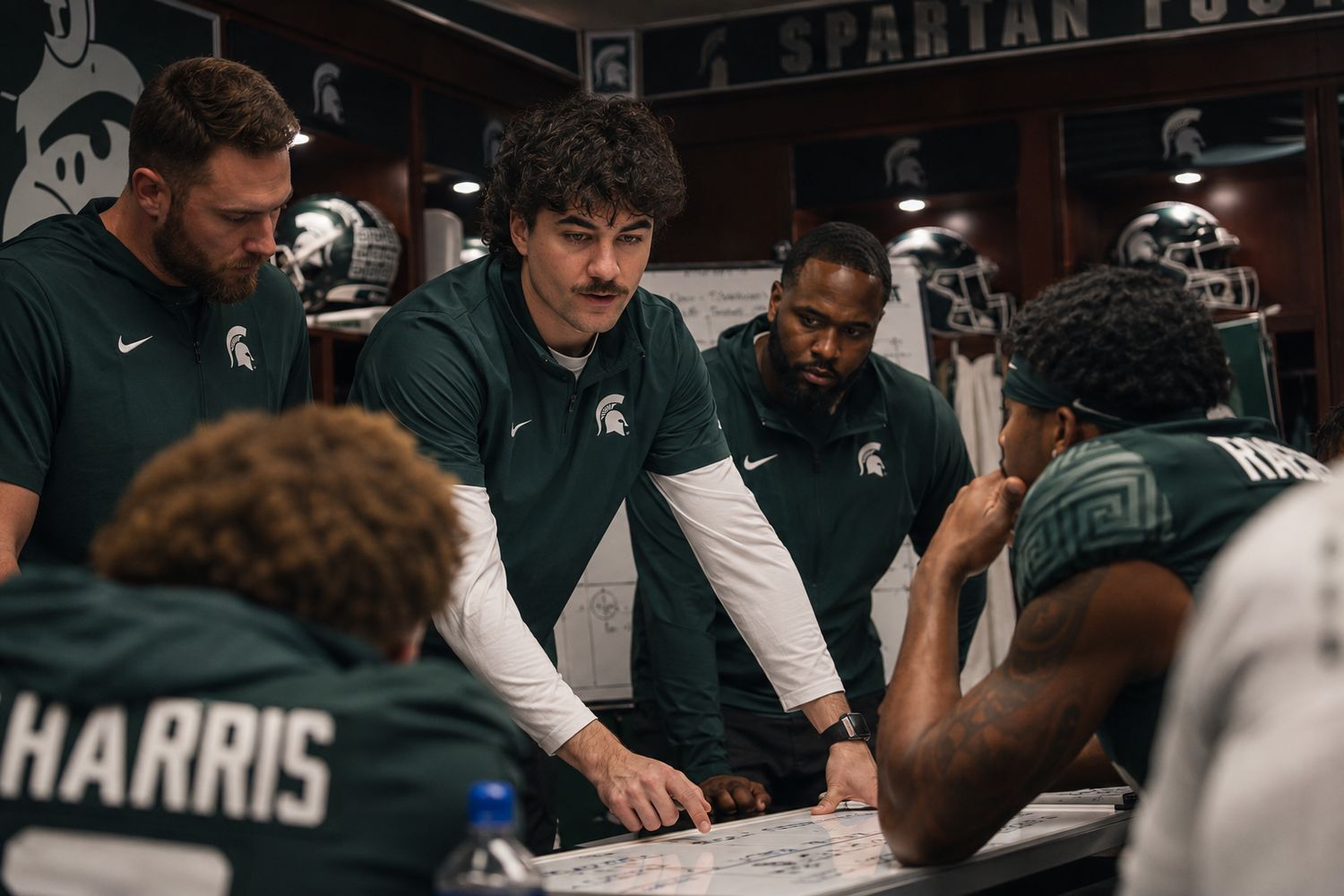
This is a fictional feature, part of a Michigan State college-football dynasty simulation. Every person, document and exchange described here is invented for this creative project. The game has not been played.