
There is no evidence yet. Michigan State is asking anyway.
Nick Mansour has never coached a college football game, and Saturday against Grambling State won’t tell you much either. In the meantime, a fan base, a locker room and a few families are being asked to take a stranger’s word for it.

Lou Dabrowski kept the envelope, because Lou Dabrowski keeps things.
The renewal notice came in March. He put it on the kitchen counter in Okemos, under the bowl where the bananas go, and left it there for nine weeks. Then he threw it away.
Forty-one seasons of Michigan State football tickets, two seats on the west side, and this is the first September since 1985 that he does not have them.
He is 66. Bad hip. A daughter in Chicago. A garage he has been meaning to deal with since the Obama administration. When I came by Tuesday afternoon he was wearing a green windbreaker from a bowl game in the nineties with a paperclip where the zipper pull used to be.
He wanted me to understand it was not about the new coach. He said that before I asked and then again ten minutes later on his own, so I will pass it along twice, the way he gave it to me.
“It’s not a protest,” he said. “A protest means you still want something. I stopped wanting something. There’s a difference and nobody believes me about it.”
He can tell you the exact Saturday he decided. He told me. I am not printing it. It involves somebody’s kid having a very bad afternoon in front of 60,000 people, and Lou has decided that young man has been punished enough by strangers.
The money was part of it, he said, and then he took that back himself. “The money’s the excuse. Don’t let me get away with the money.”
Michigan State hosts Grambling State on Saturday at noon. It is the home opener and the first game of the Nick Mansour era, and most of the people saying era are being sarcastic when they say it.
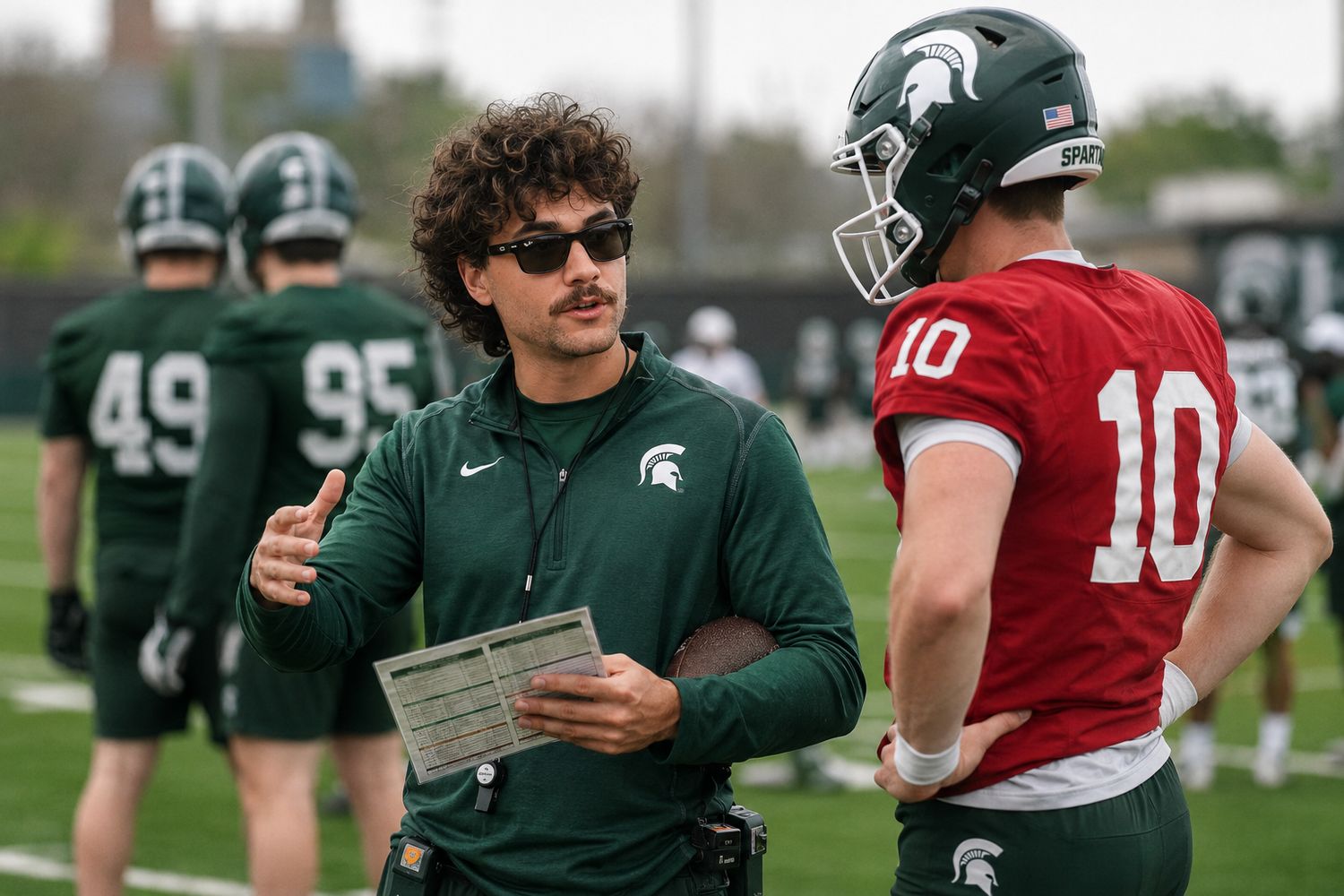
Mansour is 28. He has never coached a college football game at any level. He never played the sport, not one down, not in high school, not anywhere. He was in the marching band.
What he was is very good at evaluating players for a living, very good on the internet, and a high school head coach for a single season. Michigan State gave him the whole football operation and let him call both sides of the ball himself.
Everything anyone believes about him this week, they believe because of sentences. Sentences he has said, sentences other people have said about him. That is the entire file.
And the bill went out anyway, in March, to about 60,000 people, one of whom was Lou.
The people who answer the phone
Kendra Boonstra is 27 and has worked in Michigan State’s ticket operation for six years, which means she has been the human voice of two rebuilds and one coaching change.
She would not give me renewal numbers. The athletic department would not give me renewal numbers either. Make of that what you like.
What she would give me is the shape of the calls.
“Nobody asks if we’re going to be good,” she said. “That’s not the question anymore. There’s a nice version and a real version. The nice version is, do you think it’ll be fun this year. The real version is somebody asking me, personally, on the phone, whether it’s going to be embarrassing.”
A man in the spring kept her on the line for 22 minutes asking her to explain why he should hand the athletic department another $1,400. She told him she understood. She meant it. She also makes $19 an hour and does not set the direction of the football program.
“I don’t argue with them. You can’t. What am I going to say, trust us? We’re the ones who say trust us.”
Rita Kalogeras has run the same restaurant on Michigan Avenue for 19 years and can tell you the health of Spartan football by chicken.
The last two seasons she cut two people off the Saturday afternoon schedule after two o’clock. By the middle of the third quarter of a home game her dining room emptied out and did not refill. People stopped watching the fourth quarter in public.
This Saturday she is staffing full and ordering like it is 2015.
“Don’t write that I’m optimistic,” she said. “I’m hedging. If nobody comes I eat forty pounds of chicken and I’m annoyed at myself for a week. If they come and I’m short, I lose the night and everybody’s mad at my daughter, who works the front.” She thought about it. “It’s cheaper to be wrong in the hopeful direction. That’s not the same as hope.”
What a family gets told
Fans lose Saturdays and money. Families lose years. That is the part of this week nobody is polling.
Yvette Bell got the call in April, at work, and the first thing she understood was that somebody wanted to move her son off the position he had played since he was nine.
Tre Bell is a cornerback. He has been a cornerback his whole life, the way some people are left-handed. The new staff wanted him inside, at a job with a name that sounded to her like a substitution rather than a position.
“I’m his mother, so I heard demotion,” she said. “That’s what a mother hears. You are taking my baby off the outside and putting him in a package.”
Mansour came to the house. She was expecting a sales call and got a legal pad.
He drew it. She still has the page, she says, in a drawer with her son’s high school certificates. What stayed with her was the order in which he said things.
He did not open with a promise. He opened with the number of snaps he thought the job was worth, and then he told her, before she asked, what could go wrong with it.
“He said if Tre can’t tackle in there, then we’ve wasted a year of my son’s career, and that would be his fault and not Tre’s. I didn’t ask him for the bad part. He just handed it to me first. I have been in a lot of living rooms with a lot of coaches and nobody gives you the bad part first.”
She is not a convert and she was careful about that, so I will be too.
She said “I like him” twice, and then: “I liked the last one too, and the last one was lovely to me right up until he wasn’t here anymore.”
Her position, as best I can put it, is that she has decided to let her son believe it, because a player his age needs to believe something, and she will hold the doubt herself so he does not have to carry it.
Another parent, the mother of a redshirt freshman who asked me not to name her son, gave the new staff nothing at all.
“He called me when my son got hurt in the spring. Fine. Great. Nobody called me the year before, so I know the difference. But a phone call is the minimum. He doesn’t get a medal for the minimum. Ask me in November, when there’s a decision about my kid that costs somebody something. That’s when I’ll know what the call was.”
She said she has stopped listening to the way coaches talk about her son’s future and started counting his reps instead. “I can read a practice report. I can’t read a man.”
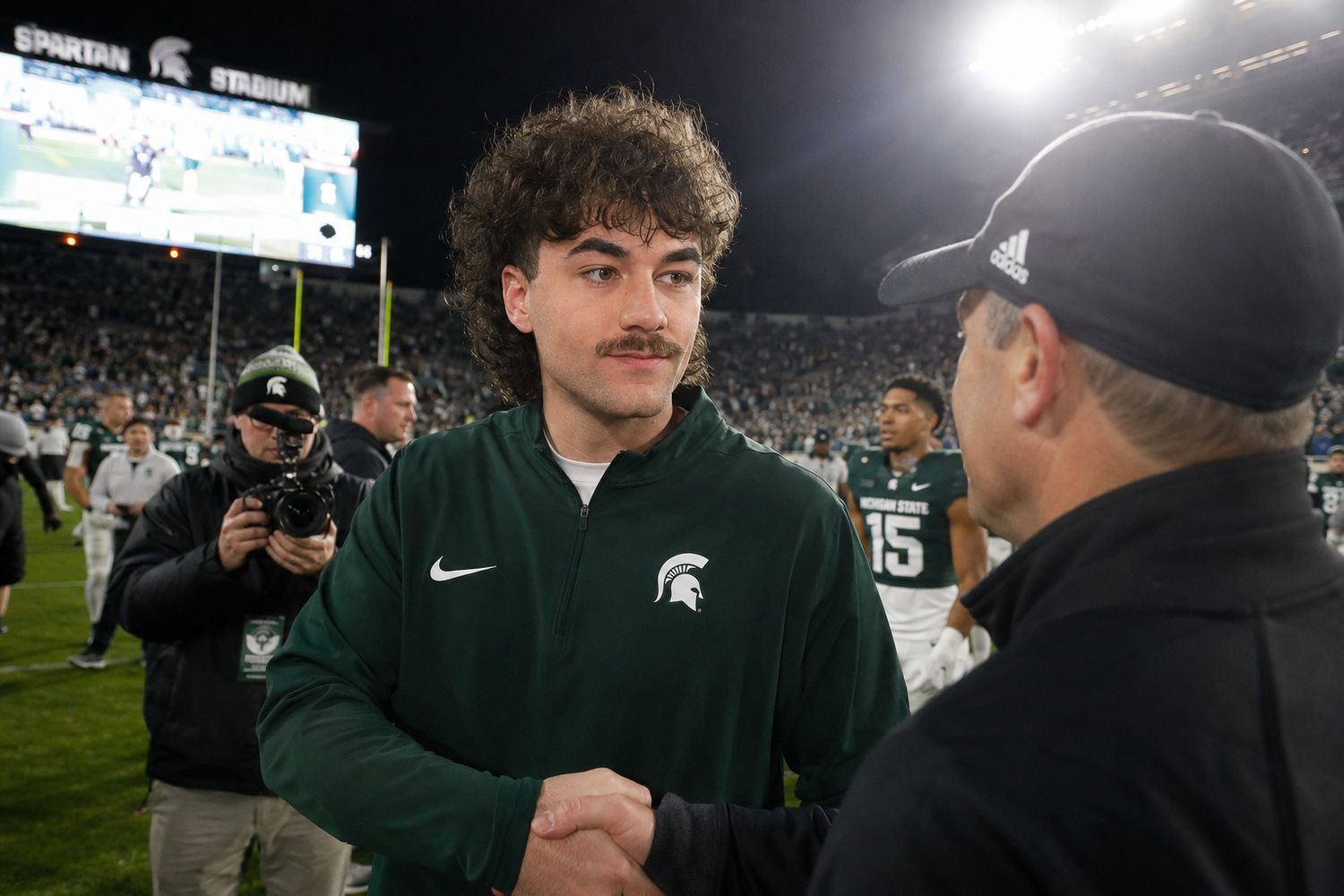
I went to that open house. I stood off to the side for most of it with a notebook.
Three small things I watched, and I am going to hand them to you without telling you what they mean, because I do not entirely know.
The first. Parents kept giving him their phones so he could pose with their kid. Eleven times in about 25 minutes, he took the phone and immediately passed it to a staffer standing behind him, so the parent could get in the picture too.
He never explained he was doing it. Almost nobody noticed, because the parents were mid-sentence and nervous. He just kept doing it, like a man clearing dishes.
The second. A donor in a navy quarter-zip came over to shake hands, and Mansour turned him ninety degrees and introduced him to the woman running the check-in table. By name, and then by what she actually does the other five days of the week.
Fifteen seconds, and the donor was suddenly having a conversation he had not planned on. She was still talking to him four minutes later. I watched her face while it happened. Pleased, and a little annoyed, in the way of a person who now has to be charming at work.
The third happened Tuesday and not Sunday. At the end of a media availability, Mansour asked me about a colleague of mine who had a health scare in July, by name, and asked a follow-up specific enough that he clearly already knew the answer to the first question.
Then, in the identical voice, at the identical volume, he declined to tell me one thing about who is playing right guard on Saturday. Warm and completely unhelpful, one sentence after the other, and I could not find the seam.
I do not know what any of that is worth. It is not a football credential. It is also not nothing, and I have covered enough coaches to know how rarely you watch a man do the small unglamorous version of a thing when there is no credit available for doing it.
Then again, a very good salesman does the small version too. That is what makes him good.
The ones who never left
Gus Nieves has been in Michigan State’s equipment operation for 26 years. He has outlasted head coaches, athletic directors, two renovations and one flood, and he is romantic about none of it.
He measures football staffs by one thing, which he explained to me with the patience of a man explaining it for the fifth time.
“Practice ends when it ends. Fine. But my student managers have class. If practice runs twenty minutes long every day, that’s not a football decision, that’s twenty minutes off a nineteen-year-old’s night, five days a week, and he’s the one who eats it, and nobody upstairs ever finds out.” He shrugged. “That’s my whole scorecard. I’ve had staffs that fixed it in a week and staffs that never heard me say it out loud in four years.”
Mansour asked him in February what the last staff did that made his job harder. Gus told him about the twenty minutes. The schedule moved the following week.
He is under no illusions about what that proves. “Twenty minutes isn’t a program. I’ve been here for guys who were great in February.”
Kwame Boateng is a senior in the video operation, and his data set is unusual, because Mansour is the only head coach he has ever worked for.
Kwame gave me two facts and left them sitting next to each other without smoothing them out. One, the head coach learned every name in the video room inside a week, including the two part-timers who only come in on Sundays. Two, in August he made Kwame recut the same six-play sequence four times, and never apologized for it, and never got warm about it either.
“People keep asking me if he’s nice,” Kwame said. “I don’t know what to tell them. He’s the same the whole time? That’s the weird part. My friends want a story and I don’t have one.”
A woman in academic support told me in August that you can tell a real staff by whether the coaches know a player’s Tuesday. Not his major. His Tuesday.
I called her back this week to ask whether anything had changed. She laughed at me. “Ask me at Halloween. Nothing you learn in August is true.”
The man who isn’t buying it
Owen Marchetti has been the head coach at the same Michigan high school for 19 years, and four different Michigan State staffs have come through his building. Three of them told him personally that he was a priority. There is a filing cabinet in his office full of what that turned out to mean.
He is the most useful skeptic I found this month, because his objection is not “he’s 28” and is not “he was in the band.” He waved both of those off inside a minute and was mildly insulted to have been asked.
“I don’t care that he never played,” Marchetti said. “I’ve got one coordinator who played in the Big Ten and one who never suited up past freshman year, and I’d take the second one in a fight. And the age thing is lazy. My best assistant is 26 and he’s smarter than me on third down.”
What bothers him is that Mansour is running both sides of the game by himself, and he has watched what that does to a person.
He coached a playoff game once against a young head coach who called both units. A good coach, he said, and then said it a second time so I would not print it as a shot. He watched that team’s defense play an entire drive with the wrong group on the field, because the head coach was heads-down writing his next offensive series.
“He didn’t get dumber,” Marchetti said. “He ran out of himself. There’s only so much of a person and he spent it all by the fourth quarter. That happens to real coaches and it doesn’t show up in July.”
Then he said the thing I have been chewing on for a week.
What makes him honest instead of a useful prop is that he uses the man’s work anyway. Marchetti sent his offensive coordinator one of Mansour’s old breakdowns, a run-game thing from years ago, from the internet, from before any of this, and they installed a version of it. He volunteered that. He was not happy to volunteer it.
“I’m not saying he’s a fraud. I’m saying I’ve been dumb about people before, and I’ve got 60 kids, and one of them might be a Michigan State recruit someday, and that’s the day I have to be right about him. So, no. Not yet.”
Caring again, against her will
Sasha Pruitt graduated from Michigan State in 2015 and quit the football team in 2024. Not the team. Her relationship with it.
She deleted the app. She muted the group chat with her brother and her cousins that had been running continuously since college. She took up pickleball, which she says is a cliché and she does not care. Two very good years.
Two weeks ago she caught herself at 11:40 on a Tuesday night, on the couch in Royal Oak, watching a seven-year-old video of the Spartan Marching Band doing a pregame entrance.
“I’m the idiot in this story,” she said. “Put that in. I told every person in my life I was done, and I was smug about it, and then I sat there at midnight watching a trombone.”
She is driving over Saturday. She unmuted the chat, which her cousin clocked within an hour and has been mocking her for since. She is furious about all of it in a way that is very funny to talk to.
Then about twenty minutes in she gave me the real reason, and it had nothing to do with the football team.
Her father is 74. He has had tickets in some form since the Nixon administration, and he had a heart thing in February that everyone in the family has agreed to call a scare. She did the arithmetic this summer that adult children do, which is how many home openers are realistically left if you are being honest with a calendar.
“So I’d rather tell you it’s the new coach,” she said. “It’s a better story. It’s not why. My dad’s excited, and I don’t get many more of those, and I’m not going to sit in Royal Oak being too cool for it.” She stopped. “Am I crying? I’m not crying. It’s allergies. It’s September.”
The room itself
The players have to extend this credit whether they want to or not, which makes them the least free people in the arrangement and, in my experience, the most interesting to ask.
Cam Edwards transferred here to be the centerpiece of the offense and treats the whole subject like a payroll question, which was a relief after a month of people being profound at me.
“I already did the trust part,” he said. “Everybody else out there gets to sit and wonder about it. I signed. That’s done. It’s a job, I’ve had jobs.” I asked what actually got him. He did not hesitate. “First meeting, he told me what I’m bad at. Nobody does that when they recruiting you. Everybody else was telling me what I am.” Then he looked at me in a way that ended the interview, which it did.
Jordan Hall, a linebacker, was harder work, in a way I enjoyed. Does the team feel any of the nervousness outside the building?
“Yeah, no, for sure.”
That was the whole answer. I waited. He waited better than I did.
So I asked it differently. Does anybody in there actually read what is being said about this game?
“Um. Kinda? I don’t, honestly, I don’t read it.” Pause. “Like, my mom reads it.” Longer pause, and then, cheerfully: “So I hear about it. She sends it. She sends me the bad ones and then she goes, ignore this.”
Leo Hannan, the redshirt freshman making his first career start at quarterback, has clearly been coached, does it well, and said almost nothing to me for four minutes. The ball, the process, the guys up front, one day at a time. A practiced performance of something he has watched other quarterbacks do on television.
Then I asked him what his mother said when he was named the starter, which is not a question anybody preps you for, and he answered flatly and with no packaging on it at all.
“She asked if she could get tickets in a section where people won’t say stuff about me.”
Two seconds of nothing. Then he found the rails again and told me how much he trusts the offensive line.
An interior offensive lineman I stopped in a hallway declined, politely, to say one word about the quarterback decision. “I block whoever’s back there. That’s above me.” Fastest anybody all week said nothing to me.
What Saturday can and cannot pay for
The football people are not relaxed about this game and I no longer think that is silly.
Grambling State runs an old-fashioned running offense and is good at it. Translated out of coach and into English, that means eleven young men who have never done this together each get one small unglamorous job, and every one of them has to do his on time, for three hours, in front of everybody.
This defense has not played a snap together. Grambling has been practicing the question since long before Michigan State knew who its head coach was.
They are here on a guarantee, which is how this economy works, and they are also here because they are proud and they are good at the thing they do. Nobody at Michigan State has been sloppy about that in public, which I noticed and wrote down.
What can the afternoon actually deliver? Not evidence. Nothing that happens against an FCS opponent settles whether a 28-year-old can run both sides of a football game in the Big Ten, or whether the man who has been telling everybody the truth in August is still telling it in a week when the truth is expensive.
All Saturday can do is fail to make things worse. Look like a program. Play a clean, adult, boring football game and hand the internet nothing.
It is a humiliating thing to be hoping for, and everyone involved knows it, and I have not heard one person in those offices pretend otherwise.
I called Lou Dabrowski back on Thursday, because I wanted to check a detail about the envelope.
We did the detail in about forty seconds. Then he asked me what time kickoff was.
I told him. He said, “Huh.” He said he would probably have it on while he worked in the garage. He said, unprompted, twice, that it did not mean anything.
Then he asked whether I thought the young quarterback was going to be all right, which is not a question you ask about a thing you have stopped wanting.
I asked what he would do if it turned out to be good. Not Saturday. The whole thing, if it actually worked.
“Then I’ll be annoyed,” he said. “Very annoyed. I’ll have to call the ticket office and eat it, and that girl’s going to be nice to me about it, and I’ll hate that.” He laughed, and then he stopped laughing. “I’d rather be annoyed than be right. I’ve been right for eleven years and it’s the worst I’ve ever felt.”
He said he had to go. There was a man coming about the garage.