
Sign In
Subscribe
The Spartans open at home Saturday against an FCS team they are supposed to beat comfortably. Nobody in the building is treating it as a formality — partly because of who the head coach is, and partly because Grambling State will run the football forty-five times at a defense that has never played a snap.
The stadium was empty except for about forty people, two golf carts and a stack of orange cones, and at 9:15 on Thursday morning a woman from the athletic department stood at the mouth of the north tunnel with a stopwatch and counted backward out loud.
What she was running is a thing every program does the week of a home opener and nobody covers, because there is nothing in it. It is a rehearsal for the ninety minutes before kickoff. Somebody drives the route the buses take. Somebody stands where the inflatable helmet goes. A student manager jogged the width of the field holding a broom handle straight up to stand in for a flag, and when he got to the far hash he stopped and looked back over his shoulder, because nobody had told him what he was supposed to do once he arrived.
It took four minutes to sort out. The answer was that he jogs back.
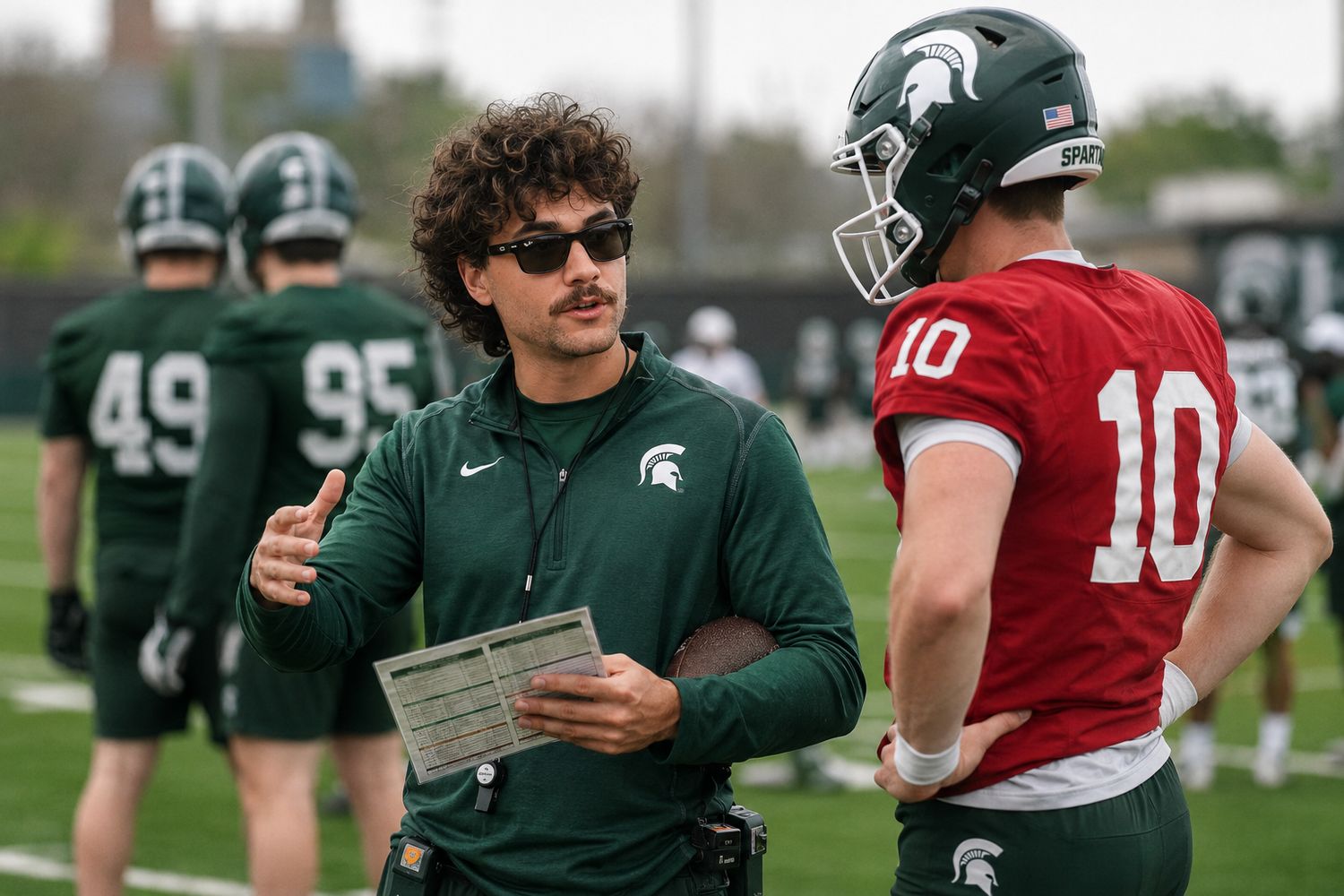
Nick Mansour was standing on the 30 with a coffee, in shorts, doing nothing at all. He asked one question in the twenty-five minutes I watched him. He wanted to know whether his team would be on the field or still in the locker room when Grambling State’s band finished its pregame, and when somebody told him, he said okay, and did not write it down.
Then he went up the tunnel, and the woman with the stopwatch ran the whole thing again from the top, because the first pass had come in eleven seconds long.
Michigan State hosts Grambling State at noon Saturday. The Spartans are 0-0, which is what everybody in the Big Ten is except USC, the league’s only Week 0 participant, and USC won. Michigan State is a heavy favorite and has been since the schedule came out. Nobody has argued about that part at any point.
The week still runs about fifteen degrees warmer than a Power Four opener against an FCS team is supposed to, and after four days in the building I think that heat comes from two unrelated places that happen to be aimed at the same Saturday. One is obvious. Michigan State hired a 28-year-old who never played the sport, handed him the roster, the personnel department, both coordinator jobs and the play sheet, and every snap he coaches this fall is going to be filed as evidence in an argument that started in December and has not moved since.
The other is that Grambling is good at one specific thing, and that thing is aimed directly at the part of this team nobody has ever watched work.
Six different people in and around this program said a version of the same sentence to me over four days. I want to be up front that it started to sound rehearsed until I remembered that none of them were on the record and therefore none of them had any reason to rehearse anything.
We need to look like a football team.
A Michigan State staffer who has been here since January, granted anonymity because he is not authorized to discuss game preparation, was the one who put it in a usable form.
“Everybody outside is asking whether he’s a genius,” he said. “Nobody in here is asking that. Nobody in here is anywhere near asking that. It’s, can we line up eleven guys on a kickoff. Can the play get in. Are we going to have twelve men on the field in the first quarter. I mean, that’s the list. It’s a really boring list and that’s the list.”
Everybody I know who has covered a first-year staff expects game week to be loud. This building has been quiet, and I want to be careful about reporting that, because staffs are very good at manufacturing calm for a visitor and any reporter describing the mood of a facility during game week is being handled at least a little.
The staffer’s explanation, for what it’s worth, was that nobody inside has been asked to defend the hire.
“It’s all out there. It’s on the radio, it’s on my mother-in-law’s Facebook. In here it’s install, correct, install, correct, same as every place I’ve worked. He doesn’t bring it through the door. Guys give him grief about the band and he’s fine about it, he laughs, and then thirty seconds later we’re back on third down. I keep waiting for the week to get weird and it hasn’t.”
Whether that survives something going wrong is the only version of the question worth asking, and everybody in the building says so, including him.
Almost nobody is going to write about the opponent, so we’ll do it here. Grambling State is an FCS program with a long history and a real identity, and it is on this schedule for the reason FCS programs are always on this schedule, which is that a guarantee game pays for a year of somebody’s department. There is a version of this week’s coverage, most of it, that treats the Tigers as furniture. That version is going to be wrong about the football even if it turns out to be right about the score.
They run the option. They run it a lot, they run it well, and they have a habit of making bigger teams uncomfortable on the ground. An option offense does not need to be more talented than you. It needs one defender a step out of place, once, and then it needs a safety to take a bad angle, and now it is 38 yards and the afternoon has a different shape.
Set that next to what Michigan State is trying to be on defense. A 4-2-5, lighter than the traditional body type in this league, built on speed, disguise, simulated pressure and defensive backs who can do more than one job. That structure has been described, diagrammed, defended and mocked for eight months. It has never been played.
Joe Rossi, the defensive coordinator, has run defenses in this conference a long time and is by consensus the most conventional line on this staff’s résumé. Somebody asked him Tuesday whether opening against an option team was a nightmare or a gift.
“Both. It’s both,” he said. “You’d rather find out about your run fits in Week 1 than in Week 6. You also have to find out about your run fits in Week 1.” He shrugged. “I don’t know that there’s a good answer to that one. It’s the schedule.”
What changes about the preparation?
“Schematically, nothing. We’re not being a different defense for one week, you throw away a month of teaching doing that. What changes is what a rep is for. It’s eyes. The whole thing is eyes. If your eyes are on the football, you’re gone. And that’s hard for young players, because every good thing that ever happened to them happened because they were around the football.”
An assistant at another FCS program, whose team has played four guarantee games in six years and who asked not to be named because he did not want to be quoted about somebody else’s opponent, was blunter about what the game actually is.
“Everybody at that level wants to open with a team that throws it forty times, because then your guys just win on talent,” he said. “The option is the other thing. Option makes you be correct, and it finds the one guy who isn’t. It always finds him and it finds him early, like inside of two possessions. That’s not a scheme opinion, that’s just what happens.”
The most instructive thing I saw all week was a whiteboard, and I only saw it because a door stood open for maybe half a minute while a defensive meeting let out.
Three columns across the top. DIVE. QUARTERBACK. PITCH. Under each one, a list of names. Not positions. Names.
Here is why that is strange. The conventional way to defend an option team is by call: you have a defensive call, the call plus the offense’s formation assigns each player his option responsibility, and the players learn rules that convert those two inputs into a job. Nearly everybody does it that way and there is nothing stupid about it. It keeps you multiple. It lets you change the picture. It makes you harder to block.
Michigan State went the other way. According to three people with knowledge of the plan, option responsibility this week is fixed by player, for sixty minutes, regardless of call, formation, motion or field position. The same man has the dive on every snap. The same man has the quarterback. The same man has the pitch. The defensive calls were then written backward to fit around those fixed jobs.
“Complex for opponents, simple for us” is a line Mansour has been repeating since his introductory news conference, often enough that it now turns up on message boards as a punchline. This is the first time it has cost anything.
Because it does cost something, and Rossi said so in the room. Several people described that conversation and none of them described it as tense. It went on a while, and at least two other people argued the same side Rossi did. Fixed assignments are findable assignments. A staff that runs the option for a living will have identified Michigan State’s permanent pitch player by the second series, and then they will build at him on purpose. Cut him. Load the play side. Run away from him and make his speed worthless. A defense that assigns by call forces an offense to solve a moving problem. This one asks them to solve a man.
By two accounts Mansour agreed with all of it in about a sentence and then made a different argument.
Option teams, he said, do not beat you by being right about your structure. They beat you on the snap where somebody hesitates. The damage in these games is concentrated in a handful of explosive runs, and those runs almost never come from a defense that got outschemed. They come from a defense that was briefly unassigned. Two men on the same job. One gap with nobody in it for half a second.
Which turns the choice into a question about which failure you would rather have. Being attacked at a known point is something you can rehearse every day of the week. Being unassigned cannot be rehearsed at all, because you do not know where it is going to happen until it has already happened.
Then the part that made two coaches I described it to on the phone ask me to say it again: the fixed jobs were not handed out evenly. The heaviest, most physical assignments went to the linebacker room, which is the deepest and most trusted group on this roster. The lightest-contact job went to the nickel. The structure got built around which of his people he trusted with what for four quarters.
“That’s the part I’d steal,” said a Big Ten assistant who has coached against option offenses and was granted anonymity to discuss another program’s plan. “Everybody says simplify. Simplify is a word, it doesn’t mean anything by itself. Deciding which guys eat the simple version and which guys eat the hard version, based on the actual dudes you have, that’s a coaching decision. I don’t know if it works. It’s a decision.”
He wanted something else on the record and got to it without me asking.
“It’s Grambling, man. Everybody’s going to watch a Power Four team play an FCS team and write two thousand words about what it means. I’ve won those by 45 with a 5-7 team. I won one by nine with a team that won our division. It’s not a data point.” Pause. “Although if they can’t fit the run against an FCS option team while they’re playing light, yeah, okay, that is a data point and I’d look at it, and I’d be lying if I said I wouldn’t. So I don’t know. Both of those are true and I’m not going to pretend they aren’t.”
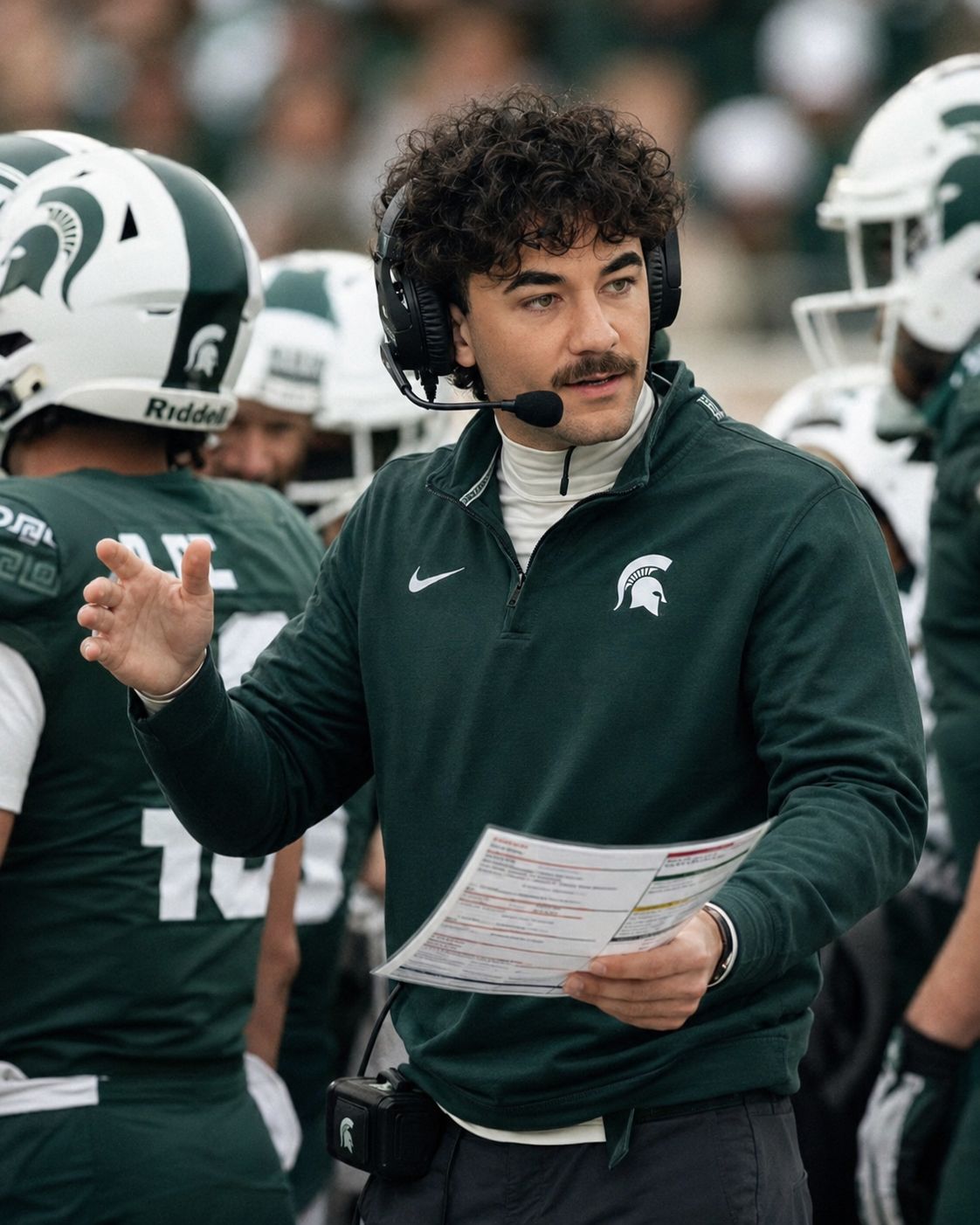
Leo Hannan makes the first start of his career Saturday, and no version of this week is not partly about that. The decision has been public since spring and has not gotten more comfortable with time. Alessio Milivojevic stabilized a bad offense last season, is accurate, is respected in that locker room, and by any conventional method of picking a quarterback had earned the job. Mansour took the redshirt freshman. He has never once framed it as a competition Milivojevic lost. He has framed it, repeatedly and a little bluntly, as a bet on what Hannan might become.
Not everybody in the room landed where the head coach landed.
“I want to say this right,” said a fifth-year Michigan State player, who asked for anonymity because he did not want it read as a shot at a teammate. He asked twice how he would be described.
“I think it’s the wrong call. I do. And I’m not the only one who thinks that, so it’s not like I’m breaking news to you here. Alessio is the reason last year wasn’t a disaster. That’s not a stats thing. He held it together. And now it’s a nineteen-year-old and the reason is upside.” He said the word slowly. “Upside. Okay. I’ve got one year left. I don’t have upside.”
Then, without being asked: “The part that messes me up is he told me. Before it came out. Sat with me a long time, and he didn’t sell it. He didn’t do the thing where they tell you it’s a competition and it isn’t. He said why, and he said what could go wrong with it, and he said if it doesn’t work that’s on him and not on Leo. And I was mad the whole time and I couldn’t find the place where he was lying to me. That’s worse. It’d be easier if he lied.”
Is he with it?
“I’m with the season. I’ve got twelve games left in my life, I’m not spending them being mad at somebody.” Pause. “I don’t know. That’s the honest answer. I don’t know yet.”
Hannan, at 19, is already a good quarterback interview, which is a compliment and a slightly depressing thing to notice. He is careful. He says “we” constantly. On Tuesday a reporter asked about his own footwork and he answered about the offensive line.
“I think the biggest thing is just executing,” he said. “The coaches have put us in a really good spot all camp. Coach Sheridan, Coach Mansour, they’ve been really clear about what we’re trying to do, and my job is to be on time with the football and take care of it. We’ve got good players around me.”
Twelve reporters, twenty minutes, about two hundred words of that. Then somebody asked what he did Sunday night.
“Oh. Uh, we watched Miami and Notre Dame,” he said, and laughed for the first time. “Me and my roommates. That was a weird one to watch. We were all kind of sitting there like, oh.” He heard it about half a second late. “Sorry, that’s — I mean everybody watched that game. It’s a good football team. Um.”
He got back on the rails and nothing else got out for the rest of the session.
An offensive staffer, granted anonymity to discuss the quarterback’s preparation, said the outside question about Hannan is the wrong one.
“It isn’t can he handle Grambling. He can handle Grambling, that’s not a real question. It’s how much do we want on him in the first one, because whatever we put on him is what we learn about, and whatever we take off him we don’t learn about until it costs us something.”
Which way did they go?
“More than you’d think.” He would not go further, and then he did a little. “He’s not out there to hand it off. That’s not what this is.”
Jayden Savoury did the first media availability of his life on Tuesday and it went the way those go. He is enormous, and he sat with both hands flat on the table like somebody had told him to do something with them. Asked what he had been working on, he said “everything,” then apologized for saying everything, then said “blocking, mostly,” in a way that suggested he had been told to say blocking and also that it was true.
He is a redshirt freshman listed as a fullback and H-back rather than a tight end, a distinction this staff wrote down on purpose. He was on nobody’s projected two-deep in February. He is going to be on the field a lot Saturday.
The romantic version of that is that Michigan State found a mismatch. The people who made the decision describe something duller. They did not put him out there for his hands. They put him out there for where he stands.
The reasoning, as three people described it, runs about like this. Michigan State’s central offensive problem is a first-time starter who needs information before the snap. Defenses give you information when you force them to declare, and you force them to declare by putting a body somewhere they cannot ignore and cannot cover with the eleven they already have on the grass. A move piece who can align in the backfield, on the line, in the slot or detached changes the math four different ways out of one personnel group, and every one of those ways makes somebody on defense move first. Walk a safety down. Widen a linebacker. Rotate the coverage early. Whatever they pick, the quarterback has his answer before the ball is snapped.
“He might be a weapon eventually. We think he can be,” one of those people said. “That’s not why he’s playing this week. He’s out there to make them tell us what they’re in.”
Savoury’s mother watched a clip of the availability that night.
“He hated every second of that,” Yolande Savoury said, on the phone from outside Toledo. “That child does not like a microphone. He’s been that way since he was about four.”
She found out her son would matter this fall the way parents find out most things, which is late and sideways.
“There’s a group chat with the other mothers and somebody put a screenshot in it before Jayden said one word to me. So I called him and he goes, ‘oh, yeah.’ That was the conversation. ‘Oh, yeah.’”
She had one thing to say about the coach and was clear that it was the only thing she had.
“In the spring he was down about something, and he wouldn’t tell me what, they don’t. Three days later he mentions Coach Mansour came and found him. Not called him in. Found him. And whatever got said, it wasn’t a pep talk, because my son does nothing with a pep talk, and he came off it with a list of things to do. He is a list kid. Somebody worked that out about him in four months.” She stopped. “That’s all I’ve got. I don’t know anything about football.”
Is she nervous?
“He’s nineteen and he’s starting at Michigan State for a coach that men on television call a joke. Yes. I’ve been nervous since December.”
Rustin Young is 6-foot-7, has played offensive tackle his entire life, and is listed as Michigan State’s starting center. It is the most argued-about line on the depth chart and it deserves to be. Centers are short for a reason. A leverage fight is won by whoever gets underneath the other man, and there is more of Young to get underneath. He also has to snap the ball with one hand while the rest of him is already blocking, and identify the front, and make the calls, in a job he started learning in the spring.
The case for it is equally real and this staff makes it without decoration. He is the best athlete on the line. The center touches every snap, works in more combination blocks than anybody and climbs to more linebackers, so that is where an athlete pays off most often.
Young has been asked about his height since he was fourteen and has run out of ways to be interested in it.
“It’s lower,” he said, when somebody asked what was different about the position. “Everything’s lower. You get used to it or you don’t.” Somebody asked whether the calls had been hard. “They were in April.” Somebody asked if he liked playing center. “I like playing.”
Nick Sheridan, the offensive coordinator, was more forthcoming and also careful.
“What people miss is that it isn’t only about Rustin,” Sheridan said. “If he’s got the front sorted, then Leo’s only got the coverage to sort. If he hasn’t, Leo’s doing two jobs at once and he’s nineteen years old. So it looks like an offensive line decision on the page. In practice it’s a quarterback decision.”
Nobody on this roster is better than Cam Edwards and nobody is worse at being interviewed, a trade he appears to consider entirely fair. Asked Tuesday how this offense compares to where he came from, he said, “Feels like an offense.” A reporter waited him out. Edwards did not fill the silence, and eventually the reporter tried a different way in: what is different in the run game?
“Angles some. Tracks are different. It’s good. I get downhill.”
Another reporter, close to desperate: is it a lot, being the guy everybody expects things from?
“Nah.”
There was no edge in any of it. He was pleasant about it. Each question seemed to get weighed against the actual work of playing running back, found light, and answered anyway. Then somebody asked about the offensive line, the one subject everybody assumed he would step around, and he answered it flat.
“They young. They work. Some of it’s gonna be ugly, that’s fine, that’s where we at.” He thought about it for a second. “Ain’t my job to grade nobody. My job is be right on my aiming point so they know where I’m at. Backs mess that up all the time and then be blaming the line.”
It was the longest thing he said all afternoon.
Walt Kreiger has worked in equipment at Michigan State for 21 years and has outlasted four head coaches, which he mentions with the flatness of a man who does not intend to make it five. Asked whether anything is different this time, he offered a scheduling note.
“Meetings start at five past,” he said. “Used to be on the hour. Now everything’s :05 and :35.”
I asked why that mattered and he looked at me like I was slow.
“Because nobody’s sprinting. You ever watch a hundred and twenty guys try to get from a team meeting to position meetings with zero minutes in between? Somebody’s late every single day. Then somebody gets chewed out for being late when the actual problem is a hallway. It’s five minutes. It fixed a thing that annoyed everybody for eleven years and nobody ever said out loud.”
He shrugged.
“That’s not football. I don’t know anything about the football. What I know is he came down in February and asked me and two of my guys what we’d change if anybody let us, and then he did three of them. Hadn’t happened to me before. I’m not telling you he can coach. I’m telling you he asked.”
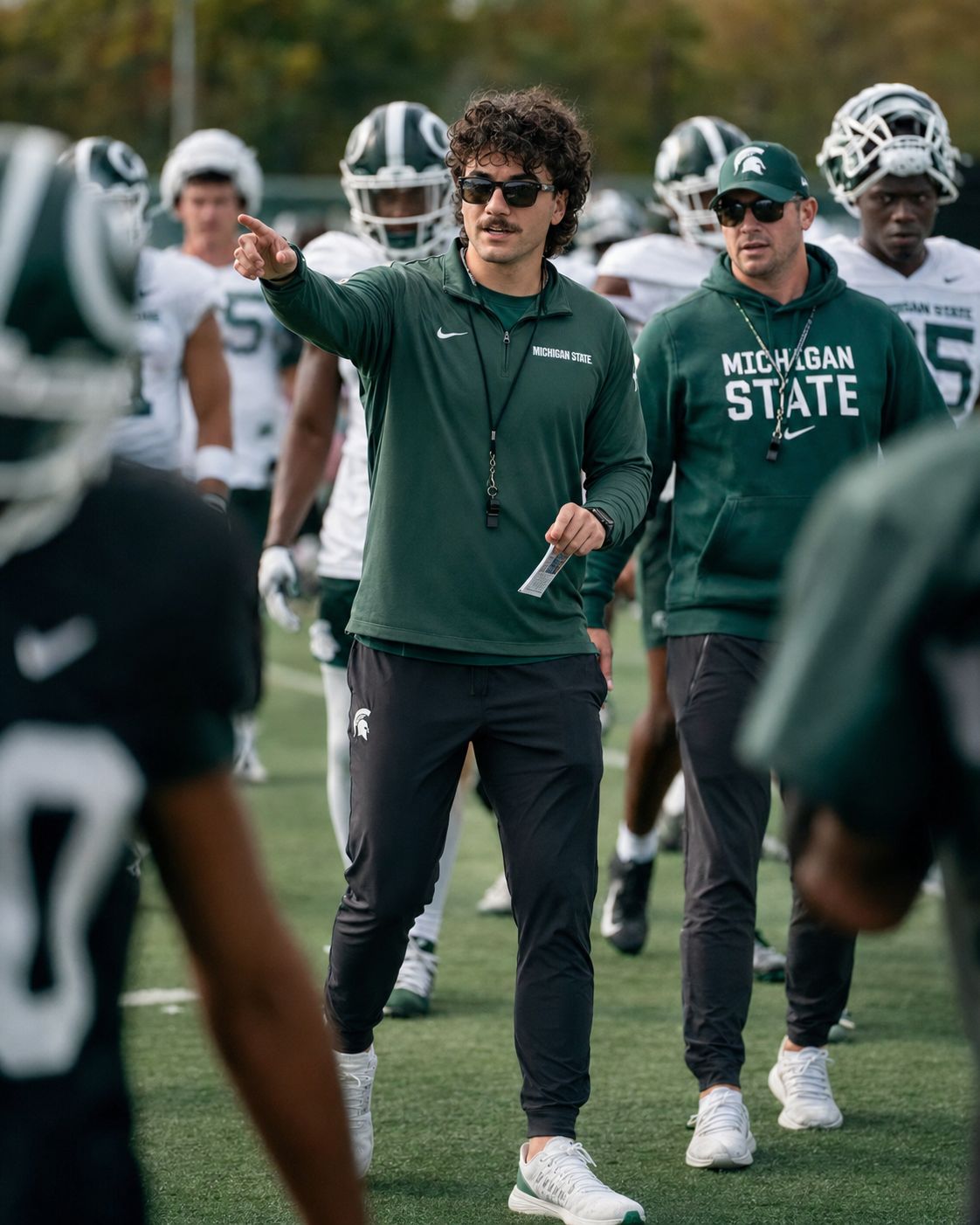
The loud complaints about this hire have not changed since December and are not complicated. He is 28. He never played. He was in the marching band. He made videos on the internet. That is what talk radio is arguing about and it is what talk radio will be arguing about in November.
A former Big Ten head coach, out of coaching now and granted anonymity because he still works in the sport in another capacity, went through his own objections in order, and none of them were about age.
“One. He’s calling both sides. Everybody wants to argue about whether that’s possible, like it’s an IQ question. It isn’t. The issue is that a head coach’s Saturday is about eleven things that have nothing to do with a play call, and all eleven of them arrive in the same ninety seconds. Timeout. Fourth down. Take the penalty or don’t. The kid on the bench who just got beat and is coming apart on you. The officials. You need a clear head when those things show up, and his head is going to be on the next call. On both sides of the ball.”
He spent longest on the second one.
“Special teams. Go look at where a young staff’s attention actually goes. Offense, defense, portal, recruiting, media, donors. Kicking game gets what’s left. And a first-year team gives away two games a year on kicking game and nobody writes about it, they write about the quarterback. If you want me to be useful instead of just negative, that’s what I’d watch Saturday. Not the score. Watch the punt team.”
Anything on the football side of it?
“I watched two of his videos. My son sent them.” Long pause. “They’re good. They’re real good. And I want to be careful, because part of me wants to say it’s a video, come see me on a Tuesday in November, and I do think that. I also know guys I coached with for years who could not have made those, because they didn’t understand it that way, they just knew it. Those are two different things.”
He was not persuaded of anything and said so.
“I don’t know what he is. Nobody knows what a coach is in Week 1. Everybody acts like they do.”
Michigan State’s offer list, for a program coming off what this one is coming off, is aggressive to the point of rude. There are national names on it the Spartans have no recent business being near. There are also players on it almost nobody else has offered, which is the part people in the industry find more interesting. Marcus Whitman, the director of player personnel, came to East Lansing out of the public scouting world and would talk about method but not about any individual.
“We’re not offering rankings,” Whitman said. “Everybody says that, I know how it sounds. What I mean is the first thing we write down on a kid is the job. Where does he play here, who’s in front of him, what does year two look like, what does he have to turn into and is that a normal thing to turn into or is it a miracle. If we can’t write the job down, we don’t offer him, and it doesn’t matter what the number next to his name is.”
Most of the big ones say no.
“Oh, most of them, yeah,” he said, cheerfully. “We know that. The offer isn’t the ask. It’s us telling a kid what we see. Every so often one of them calls back because nobody has ever described him that specifically. That’s worth doing.”
Rival staffs have noticed, and mostly laugh first.
“It’s a real approach and it’s also a way to get told no in public forty times,” said a recruiting director at another Big Ten school, granted anonymity to discuss a competitor. “Boards are free. What I’m actually watching is whether they can hold anybody in December, because Michigan State’s problem for five years hasn’t been getting in on kids. It’s the last six weeks.”
Peter Aldrich has been giving money to Michigan State athletics for a long time and has been involved on the collective side since collectives existed. He is 63, lives in Grand Rapids, and describes his own position as “thrilled, and also I think we might be insane.”
“He got up in front of about forty people who have given this school a lot of money and he didn’t spend four minutes thanking us, which is what they do,” Aldrich said. “He gave us a plan. He told us what money buys and what it doesn’t buy, and he said, and I wrote it down, if you give me money to keep a player who shouldn’t be kept, I’ve wasted it and so have you. You don’t hear that. You hear the opposite of that.”
So he is in.
“I’m in. I also sat in my car afterward and did the arithmetic, and the thing he was describing costs about double what we have, and he didn’t say that part.” He laughed. “I don’t think he’s hiding it. I think he’s got a picture in his head that isn’t funded, and I’m not sure the people who need to hear that have heard it. Everybody’s excited right now. Excited is cheap.”
Wendell Boyce has been a head coach at a public high school in Macomb County for 19 years and has sent players to the Big Ten, the MAC, and a lot of places nobody has heard of. Three different Michigan State staffs have given him the pitch. He kept the letters.
“They all say the same thing when they get the job,” Boyce said. “We’re building a wall around the state. We’re taking care of Michigan kids. I could show you the folder.”
What would count?
“Somebody in my building in October. Not a graphic. Not a text to the kid at eleven at night. A person in my hallway on a Wednesday when it’s cold, and he’s not there for the kid everybody wants, he’s there because he saw a junior tackle on tape that nobody’s heard of. That’s the test. It’s been the test my whole career.”
He allowed one thing.
“Somebody from over there called me in June about a kid I did not expect them to call about. Not my best player. And the guy on the phone knew what was wrong with him, specifically, which means he watched enough of it to know.” He stopped himself. “It’s June. Everybody’s great in June.”
Miami went to Notre Dame in Week 0 and won 42-6. Nobody re-votes the Top 25 for a Week 0 result, so Notre Dame is still sitting at No. 3 in a poll every fan in the country is squinting at this week. Michigan State plays there in three weeks.
“I have no idea what that game is now and neither does anybody in South Bend,” the Big Ten assistant said. “Are they bad? No. That’s a good team. Did something happen to them that’s going to keep happening? Maybe. I don’t know. Are they going to be furious for three weeks? Obviously. So Michigan State’s Week 3 got harder and more confusing on the same night, and there’s nothing anybody can do about it for fourteen days.”
Mansour was asked about Notre Dame on Tuesday, in the way reporters ask questions they know will not be answered.
“I watched it, same as everybody,” he said. “Miami’s good.” He waited a second. “I’m not going to give you anything on Notre Dame. It’s not me being cute about it. We have an option team coming in here in four days, and if I spend an hour this week on the wrong opponent, I stole that hour from our players and they’d be right to be annoyed with me.”
Mansour is funny, which is a different thing from coach-funny, where a man says something mildly dry and eight people in polos laugh. On Tuesday a reporter opened a question by mentioning the marching band, and he said, “I was, yeah, and I was good, I want that part in there,” and the room laughed, and then he answered the actual question, which was about run fits, for two straight minutes without a joke anywhere in it.
Most of what he says is unusable. He answers what was asked, at length, in plain words, and then stops. Asked whether he felt ready, he said, “I don’t know. I think so. I’d be a little suspicious of anybody who said yes with total confidence, and I’d be more suspicious of anybody who said no, because then why did you take the job.” Asked about the defense he talked about Rossi for forty seconds. Asked about the quarterback he talked about Sheridan and then two players. Asked what he had gotten wrong so far, he answered fast.
“Camp tempo. I built the first ten days at a pace that made sense on paper and was too much for a team with four new starting spots on the offensive line. That’s mine. Not a strength staff thing, not a player thing. I made a bad schedule and we spent about four days getting back what it cost us.”
He is also, for long stretches, boring. He spent ninety seconds Tuesday on the mechanics of how a call gets from his sheet to the huddle, including the part where two people repeat it, and he did it patiently, and it was not interesting, and he did not appear to notice or mind.
Bill Tannous was the athletic director at the Brooklyn high school where Mansour spent his one year as a head coach. He has been watching this from a distance in a condition he describes as low-grade nausea.
“People keep calling me for the cute story,” Tannous said. “I don’t have one. He was a strange thing to have in the building.”
Strange how?
“He’d stand in my office and ask about my mother’s hip, and he’d know which hip, and I’d answer, and then he’d say something like, I need to move your best player to a position he’s going to hate, here’s why, tell me if I’m wrong about it. Same voice for both. That’s the part that got people. You expect the nice part to be leading up to something, and it isn’t leading up to anything. It’s just how he talks.”
Did anybody have a hard time with him?
“Two of my coaches. One of them never came around at all. He wanted somebody who gets loud when it goes bad, and Nick doesn’t get loud, and he read that as not caring.” Tannous went quiet for a second. “He cared plenty. He just didn’t perform it, and there are people who need it performed, and they’re not wrong to need it. If this thing goes sideways in December I’d bet that’s where it starts. Not the football.”
Braylon Collier is a young receiver who is going to play a lot and had done roughly two interviews in his life before this week. He was the only person I talked to who answered a question about Saturday like a college sophomore instead of a professional.
“Yeah, no, for sure, I’m excited,” he said. “Like. I don’t know. It’s my first real, like. You know?”
Somebody asked what he liked about the offense.
“Um. I like that I know what I’m doing?” He laughed at himself. “That sounds bad. That sounds so bad. Okay, so like last year, honestly, you’d get the play and then you’re thinking about the play the whole way to the line. The whole time. And now it’s more like, they tell you the picture, and it’s, oh, if they’re in that then I’m doing this.” He stopped. “Is this making sense? I feel like this isn’t making sense.”
Tre Bell is at the other end of the register. He is 22, has been moved from outside corner to nickel, and thinks about his sentences before he says them in a way he is faintly aware of.
“It bothered me in the spring,” Bell said. “People ask what position you play and I didn’t have a word for it. Which sounds stupid, but it bothered me. Coach said something in March, he goes, the position is what’s printed on the roster sheet, what you actually have is a job description, and yours is longer than a corner’s. So I asked him if longer was good. And he said no, longer is just longer. If you can do all of it, it’s good. If you can’t, we made you worse.” He laughed. “Which, okay. Fair.”
Was he nervous?
“Nah.” Immediately: “A little. Yeah, a little bit.”
A Power Four team is supposed to beat an FCS team. If Michigan State does, it will have proven that Michigan State is a Power Four team, which nobody disputed. If the margin is large, half the internet will decide a 28-year-old trombone player is a savant. If it is small, the other half will decide he is a fraud, louder and for longer. Neither of those is going to be true Saturday night.
The parts worth watching are small. Whether the defense is ever unassigned, which is not the same as whether it gives up yards: whether there is a snap where two Spartans have the same man and a gap is standing open. Whether a first-time starter gets a picture he can read, or whether somewhere in the second quarter the calls start arriving shorter and the menu quietly shrinks. Whether the interior of the offensive line is under construction or on fire. Whether the punt team knows what it is doing. Whether the sideline looks like it has a plan when something goes wrong, and something will.
I asked Mansour late in the week whether it bothered him that the ceiling on this game is looking competent. He did not take it as bait and did not dodge it either.
“Two things,” he said. “The first one is that it’s fair. We haven’t done anything. Nobody in this building has earned a bigger question than that one, and when people say the bar is low, I don’t feel insulted. I think, well, yeah. Look at the last three years. That’s not people being mean, that’s people being accurate.”
And the second?
“Competent is harder than it sounds. Everybody says they should beat an FCS team by 40 like that’s the floor. It isn’t a floor. It’s four hundred small things going right, and every one of them is somebody’s job, and a lot of those people have never done their job in this building on a Saturday. So if we look organized, that’s a lot of people I’m not going to get to name. And if we don’t, that’s me, because I built the week.”
He picked the folded sheet up off the table and then put it back down, because he was not finished.
“The other thing is that they’re good at what they do. If we’re careless, they will make us look silly running the football, and it won’t be an upset. It’ll be a team that’s better at one thing than we are at stopping it. That’s the thing I’m actually worried about this week. I’m not being humble about it, it’s just true.”
Thursday morning, the second run-through of the pregame script came in eleven seconds long again. Somebody suggested taking the eleven seconds out of the band’s window and was told no. They ran it a third time, it came in clean, and everybody went to lunch.