
Sign In
Subscribe
Michigan State handed its entire football program to a 28-year-old former marching band member with one season as a high school head coach. This is how it happened — and why the people who did it still can’t agree on what they did.
The people who were in the room keep reaching for the same word, and none of them love it, because the word makes them sound like they got talked into something. The word is presentation. As in: the presentation was the best any of them had ever seen. As in: they walked in planning to eliminate a candidate and walked out having to explain to one another why they hadn’t.
“I went in to say no,” one Michigan State athletics official said, and then stopped, because that wasn’t quite the story either. “I went in to feel good about saying no. That’s different. I had the no already written in my head. I had the sentence.”
He never used the sentence.
On a December afternoon, in a program that had spent three years finding new and inventive ways to embarrass itself, Michigan State hired Nick Mansour — 28 years old, a former trombone player in the Spartan Marching Band, a man whose coaching résumé fits on an index card with room left over — and gave him something schools do not give first-time head coaches. Not just the team. The operation. Roster construction. Recruiting. NIL. The portal. Staff. The scouting process. Final say, top to bottom. He will call the offense. He will also call the defense.
The sport reacted the way you would expect. Within an hour Michigan State was a punchline across four networks and roughly nine hundred thousand phones. Michigan fans treated it as a public holiday. A former Power Four head coach texted a reporter a single laughing emoji and nothing else, then followed it twenty minutes later with: “wait, seriously?” Somewhere in the churn a real question got buried, and it is the only one worth asking this week. Not whether this will work — nobody knows that, including everyone loudly claiming otherwise. The stranger question is how a serious institution, a Big Ten school with money and history and a fan base that has suffered precisely because it keeps swinging at bad ideas, arrived here deliberately.
Over the past several days we spoke with people involved in the search, people who have worked with Mansour, people around the program, and coaches and executives elsewhere in the sport who were asked to make sense of it. The answer that emerges is not a fairy tale and it is not a farce. It has several parts, and some of them contradict each other.
Start with the room, because everyone who was in it describes the same ninety minutes in almost identical language, which is unusual and, frankly, a little suspicious until you hear enough of them say it.
Michigan State’s search had reached the stage where fatigue starts making decisions. The names on the board were fine. That was the problem. “A list of guys who’d get us back to exactly the seven wins we’re already sick of,” is how one person put it. There was no candidate on that list who made anybody in the athletic department feel anything other than the low hum of having done the responsible thing.
Mansour’s name got into the process sideways — a recommendation from someone in the NFL scouting world who had used his draft material, passed along more as a curiosity than a candidacy. Multiple people described the initial reaction internally as some version of: absolutely not, but sure, we’ll listen, it’s an hour.
He did not pitch an offense.
That is the detail everyone volunteers first. Every other candidate walked in with a scheme, a staff sketch, a culture deck, a plan for the first hundred days. Mansour walked in with a diagnosis of the entire program and, according to two people present, no visible notes.
He went through the scholarship distribution and where it had gone soft. He went through the recruiting classes and identified not the misses — anyone can list misses — but the pattern underneath the misses, the specific type of player Michigan State kept talking itself into and the specific type it kept letting leave the state. He went through developmental outcomes position by position. He walked through the portal usage of the previous two cycles and explained, with what one person called “uncomfortable precision,” which additions had been solving a roster problem and which had been solving a public relations problem.
Then he did the thing that actually changed the room. He talked about the university.
“He brought up the trustees,” the athletics official said. “In a football interview. He brought up the last several years of this place — the leadership turnover, the scandals, all of it — and he said, and I’m paraphrasing but not by much, ‘Recruits’ parents read the news. You have an institutional trust problem and you have been treating it as a football problem, and that’s why your pitch doesn’t land in living rooms.’”
He paused. “Nobody had ever said that to us in one of these. Nobody had ever connected those two things out loud in a room with the athletic director in it.”
A second person in the search described the same moment less warmly. “Look, it was impressive. It was also a guy with nothing to lose telling a bunch of people who had everything to lose exactly what was wrong with them. That’s a really easy room to win once. It’s a much harder room to win in February when you’re 3-4 and the same guy needs to tell a defensive tackle’s mother why her son isn’t playing.”
Both things are true. That is the shape of this entire hire.
“I have to say this carefully, because I have clients,” said a consultant who has advised more than a dozen Power Four searches and had no role in this one. “Every search has the moment. Somebody goes, what if we did something completely different, and everybody laughs, and then you go back to the list of forty-four-year-old coordinators. It’s a release valve. It is not a conversation.”
What got his attention was that nobody laughed it off. “Somebody in there held the door open more than four minutes, and the second you do that, you own it.” He also flagged mechanics several people confirmed: a candidate who arrived by recommendation rather than off a vetted board, a compressed final stage, meetings run without the firm in the room. “Doesn’t mean it was sloppy. It means the usual guardrails weren’t up.”
Mansour grew up in Flint. He was not a football kid — this is the part his own friends bring up before anyone asks. He was small, he did not play, and by his own account he did not care about sports at all until he was about fourteen, at which point he cared about very little else.
He did not play his way into the game. He studied his way in — tape, rosters, boards, the parts of football that reward the kind of obsessive who would rather understand a thing completely than be good at it a little. People who knew him then describe a teenager who answered casual questions with paragraphs.
He came to Michigan State, studied advertising, and spent four years in the marching band. Trombone in the fall. Bass guitar with the basketball band, down near the floor through the 2019 Final Four run.
Everyone wants that detail to be charming. What is actually interesting about it is the geometry. For four years Mansour was as physically close to Michigan State football as a student can get — on the field, in the tunnel, inside the noise, traveling with the spectacle — and nowhere near the football program at all. He stood forty yards from the sideline every Saturday and a thousand miles from the building. He experienced the event completely and the operation not at all.
“We were forty yards away and it might as well have been a different planet,” said a former section leader who marched with him. “That’s the part nobody gets about him. He was so close to it and so completely outside of it.”
If you were designing a person to hold strong opinions about Michigan State football and carry zero institutional loyalty to how it had always been done, you would build something close to this.
After school came NYU, a communications degree, and a career in nonprofit PR and marketing in New York. The whole time, he was building the other thing in public: draft breakdowns, prospect reports, big boards, film clips that made a difficult concept feel obvious inside of ninety seconds, interactive draft guides that circulated every spring. Under his own name, not a fake scouting brand.
The reason people followed was not volume. It was clarity.
“His stuff was clean,” said an analyst who came up alongside him in that world. “He’d take a concept a scout would spend a paragraph fumbling and make you understand it in ten seconds. That’s a communications skill, not a football skill, and I used to tell him he was wasting it.” He laughed. “I told him to go work for a network. I did not tell him to go run a Big Ten program.”
An area scout for an NFC club started reading Mansour’s material around 2021, because his college director forwarded it as a joke. “You have to understand what most public draft stuff is,” he said. “Fifty names and a bag of adjectives. Explosive. Twitchy. Long. It’s astrology with a stopwatch.” What kept him reading was that Mansour wrote about players nobody was drafting early. Backup guards. A fullback at a MAC school.
“He’d write a role. Not a grade — a role. Here’s the offense where this guy starts four years, here’s the one where he’s cut in camp. That’s literally what I write in September, and I’ve done this nineteen years.” Then the obvious follow-up, which he did not enjoy. “No. I can’t tell you it transfers. I’m good at what I do and I’d be a disaster running a team. Those are — ” He stopped. “I’m trying to say this without sounding like I’m hedging and I’m obviously hedging. Head coach at Michigan State is not building a board.”
An agent who has represented Big Ten players for twenty years was colder about the coaching and warmer about the man. “Everybody in my business read his stuff. Nobody thought he’d be anybody’s coach.” Then, unasked: “He never took a shot at a kid, though. Eight years, and not once did he write something about a client of mine that I’d have had to get ahead of. That industry runs on some nineteen-year-old’s worst day.”
Then the résumé — the part that makes coaches put their heads in their hands. A stint as a volunteer scout for a Brooklyn high school. A year as that school’s offensive coordinator. One season as a high school head coach. Michigan State.
That is the ladder. He skipped every rung that normally takes fifteen years: the graduate assistant grind, the position rooms, the recruiting trail in a bad car, the slow apprenticeship of learning how a locker room turns on you and what it feels like the week before it does.
The criticism that he has never done any of it is not stupid. It may be the most important true thing anyone can say about him.
“I’ve got guys on my staff who could draw it up too. Drawing it up was never the job. The job is January in a kid’s living room. The job is the third-team safety who thinks he should be starting. The job is Tuesday, when nothing’s working and everybody’s looking at you. He has never coached a single Tuesday. Not one.”
That is a Big Ten assistant with two decades in the profession, speaking on the condition of anonymity to insult a peer he has never met. His view is the industry consensus. Michigan State hired Mansour anyway.
To understand why, you have to stop talking about him for a minute.
Michigan State is not poor. That is what makes the last several years read less like misfortune and more like a verdict.
The Spartans have resources, a real stadium, a proud and enormous alumni base, and an actual history of winning — Mark Dantonio built something durable here before his final seasons curdled into a team that could not adapt to the sport it was living in. Then the Mel Tucker era detonated in a way that went far beyond football. Then Jonathan Smith, brought in specifically to steady the thing, produced two seasons disappointing enough that the school found itself back in the search business with less money, less patience, and considerably less public credibility.
Around all of it hums the university’s own noise: a board of trustees that fights in public, presidents who do not last, a run of institutional failures serious enough that a lot of people in mid-Michigan are quietly convinced their school cannot get out of its own way.
So when the job opened again, the fan base did not only want a good coach. Many of them wanted evidence of basic competence. Proof that Michigan State could behave like a functional adult institution for one news cycle.
Instead it hired the band kid.
You can see why the phones melted.
But the people who ran the search describe something less inspiring and more human than either the fairy tale or the joke. They were exhausted. They had made the defensible hire and watched it fail. They had made the rising-star hire and watched it fail worse. Nobody in that room felt brave. They felt cornered.
“The safe hire had failed us twice,” the athletics official said. “At some point you have to be honest that ‘safe’ stopped meaning safe. It just means the failure you’ve already seen before. It’s the one you can defend to a donor. It is not actually less risky. It just fails in a way nobody gets fired for.”
Into that exhaustion walked a candidate nobody wanted to take seriously, who spent ninety minutes explaining the program to the people who run it.
“He knew our roster better than we did,” the official said. “That sounds like a compliment. It felt like a problem. Because if a guy on the outside can see all of this, and we’re on the inside and we couldn’t, then what exactly have we been doing in here?”
That is the part the highlight version leaves out. The presentation did not only sell Mansour. It indicted the room. And a room that has just been quietly indicted becomes willing to consider a strange idea, if only because the familiar ideas are what got them indicted.
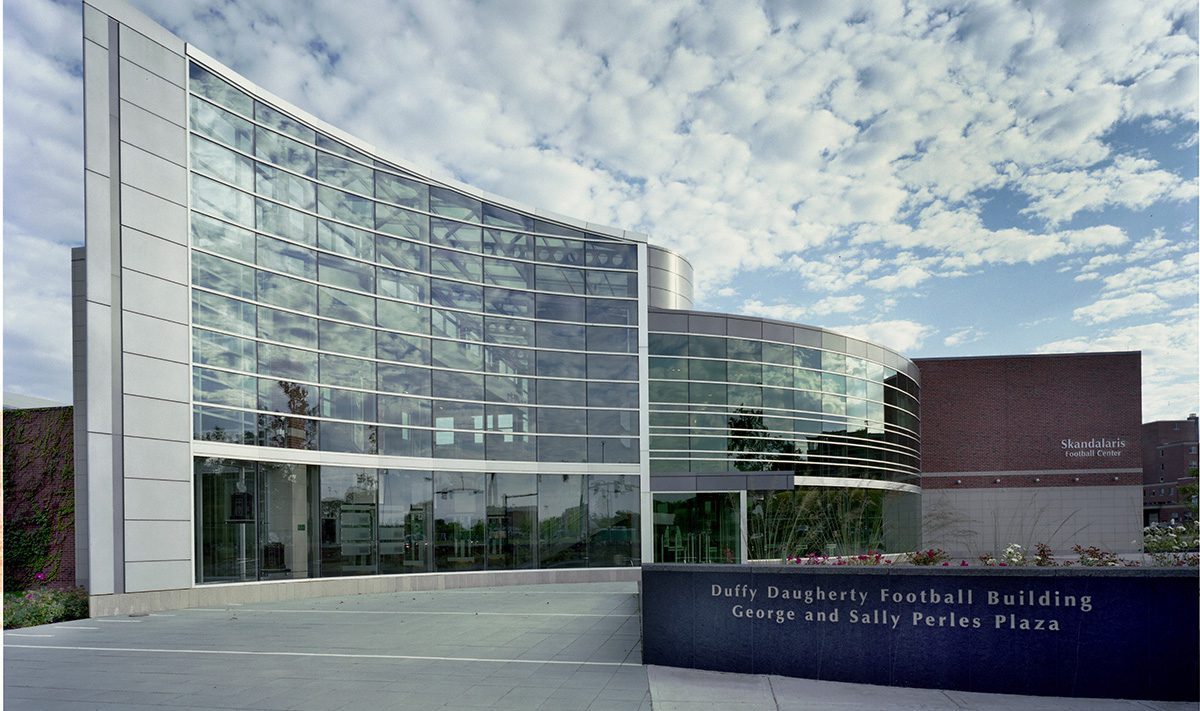
The news broke on a Tuesday at 8:52 p.m., and for about half an hour the Duffy Daugherty Football Building was the quietest place in Michigan.
A communications staffer spent that half hour in a second-floor hallway with a phone in each hand and nothing to do with either. Everything downstream belonged to somebody else’s shift. So she stood under a bank of boards turned to face the wall and watched her personal phone fill with texts. “My uncle in Grand Rapids, who has never in his life texted me about my job. Just: ‘is this real.’ No question mark.” Downstairs two people watched the coverage on a wall monitor with the sound off, which she said was worse, because you could read the crawl and watch a studio laugh without hearing why.
The athletic director’s phone rang for eleven hours. Most of it was money.
The donor base is not one animal — older givers who fund buildings, regional accounts that want to not be embarrassed at a Rotary lunch in Kalamazoo, and the impatient younger money behind the collectives, who talk about a roster the way people talk about a portfolio. They did not react the same way.
“The collective guys were fine. Some better than fine,” said a person involved in the school’s NIL apparatus. “One calls me and the first thing out of his mouth isn’t the head coach, it’s Whitman. He wanted to know if the board was really going to get run the way it sounded like. They don’t want charisma. They want to know their money’s being spent by somebody who can tell a player from a name.”
The building donors were a different call. One significant giver, who has funded facilities projects and asked not to be described in any identifying way, found out from his son-in-law and spent the first night angry. “I didn’t give to this place for twenty-six years to watch us hire an internet personality. I said that on the phone in a way I wouldn’t repeat to you.”
He was in a room with Mansour inside of a week. That was the promise the department made to the people it needed most and, by several accounts, the one it kept fastest. No money guarantees attached to the hire, no matching pledge. Just: he will be in front of you, and he will take questions until they stop.
“He didn’t sell me. That’s the thing. I’ve been sold to by every coach we’ve had since the nineties. He asked us what we thought had gone wrong, then let a sixty-eight-year-old orthodontist talk nine minutes about the offensive line without looking at his watch, and at the end told the man he was right about two things and wrong about one and said which.” He exhaled. “I’m not converted. Don’t print that I’m converted. I’m annoyed. I walked in ready to be finished with this place and he took that away from me.”
Not everyone bought it. This should be said plainly, because the “everyone was blown away” story is too clean and too flattering to the people telling it.
There were people in that building who believed the whole thing was an elegant way to get fired, and several of them still believe it. The structure of the hire is partly an argument they lost.
Because handing a 28-year-old total control is not purely a vote of confidence. It is also a decision that a half-measure version of this idea would be the worst of both worlds — that if you are going to bet on someone because of how he sees a roster, you cannot then put him in a box where he does not control the roster.
Which brings up the word Michigan State keeps not quite saying out loud. Czar. Mansour has authority most head coaches spend a career accumulating and never fully get. The upside is coherence: one vision, no turf wars, no coordinator quietly auditioning for someone else’s job, no personnel director whose board gets ignored in December. The downside is that there is nobody above the vision to catch it when the vision is wrong.
“The control is the actual bet,” said a personnel director at another Power Four program, one of the few outside voices who did not reach immediately for ridicule. “Forget his age for a second. Everybody in our world has been saying for three years that this sport is turning into pro football — that you need a real front office, a general manager brain, somebody who thinks in roster construction and role fit instead of star ratings and recruiting-service noise. Michigan State just ran the most aggressive version of that anyone’s tried. They didn’t hire a GM to sit next to a coach and get overruled. They made the GM the coach.”
He was not finished. “If you believe that’s where the sport is going — and I do — then this isn’t insane. It’s early. Those are different words and people keep using them interchangeably.”
A beat.
“I also would never in a hundred years actually do it. Early and right are also different words.”
The most useful hour I spent on this story was with somebody who lost. He works in the building, he argued against Mansour at every stage and again afterward, and he talked on the condition that nothing here identify his job.
“I’m not doing the wounded thing,” he said. “I lost. People lose. But this keeps getting framed as brave versus scared, like the only reason to say no was cowardice.” He wrote his reasons down — two pages, before the final meeting — and read from them out loud, badly, the way people read their own writing.
The first was recruiting, and not the obvious version. “Everybody asks can he recruit. He’ll be great in a living room. Here’s the actual question. Third week of October, we’ve lost a couple we should have won, and a kid we need has three schools calling him every night. They don’t have to lie about us. They say: your head coach has been a head coach for one year, in high school, and if this doesn’t work he’s gone and the guy recruiting you is gone and you’re a sophomore starting over. That’s the facts read out loud, and I don’t have an answer for it.”
Second was staff, and the January after a bad year, when a forty-six-year-old position coach with one move left in him takes a call from a program run by somebody his own age. “He’ll never say the age part out loud,” the dissenter said. “He’ll say it’s about fit.”
The third is the one he leaned on, and the one nobody in that building answers cleanly.
“Everybody’s arguing about whether he can coach. That’s not what keeps me up. My question is who catches this. If the offense doesn’t work, the guy who has to fix the offense is the guy who built it. If the roster’s wrong, the guy who fixes it is the guy who picked it. We took out every place where somebody could step in and say, we’re doing it differently now. On purpose. We called it coherence.”
Then the fourth thing, quieter. “If this goes bad it doesn’t only cost us four years. It costs us the next hire. The job turns into a punchline, and when we call, the agent for the guy we actually want lets us finish the sentence out of politeness and says no. That’s the bill. Not the buyout.”
Does he want to be right? Long pause. “No. I want to be wrong so badly I’ve embarrassed myself about it. I told my wife I’d be a nightmare and then I sat down Sunday with the install plan and read it twice. It’s good. That’s what makes it hard. It’s a good idea with no floor under it.”
The coldest outside reading came from an athletic director at another Big Ten school, more interested in mechanics than comedy. “A hire is a school finding out what it can actually afford — not in dollars, in credibility. You call, and either the agent picks up excited or he picks up polite. Michigan State found out. Everybody in this league understood that inside of ten minutes and nobody said it out loud, because we all take our turn.” What interested him was the term rather than the salary. “Cheap coach, long runway. That’s a school buying time. They’re not trying to win this league in year two. They can’t. They’re trying to still be a program a good coach would consider four years from now.” Would it work? “No. Two years of being interesting and then a search. But I’ve got a note in my phone about how they’re structuring personnel, because if the interesting part is real I’m stealing it, and I’m doing it with a forty-nine-year-old.”
The staff, read in that light, looks like the price of admission — the veterans required before anyone would sign off on the experiment.
Nick Sheridan, the offensive coordinator, is a conventional and well-regarded football man whose job is to keep the quarterback room and the weekly teaching progression from dissolving into a smart person’s chaos. Mansour calls the plays; Sheridan makes sure there is a structure underneath the play-calling, and a process a 19-year-old quarterback can actually live inside on a Wednesday.
Joe Rossi runs the defense and brings the kind of hard, established credibility that lets skeptical parents exhale — plus, everyone in the building will tell you carefully, a willingness to argue. Multiple people described the internal dynamic as healthy and slightly tense, which is how good staffs usually get described before anyone knows whether they are good.
Marcus Whitman, out of the same public-scouting world Mansour came from, runs player personnel. He is the clearest signal of what the entire operation is supposed to be: evaluation as the central organ of the program rather than a department that reports to it.
Assembling that staff did not go the way the outside assumed. Everyone figured Michigan State would have to overpay veterans to babysit. What happened, according to four people who went through some version of it, is that Mansour ran his hiring the way he ran his own interview. He sent candidates a document — a diagnosis, position group by position group, including the parts that would become that coach’s problem — with one request. Mark where I’m wrong. Bring it with you.
“Nobody ever handed me their own report card before I walked in,” said a coordinator candidate who turned Michigan State down for another job. “My first thought was it’s a trick, a test to see if I’ll suck up. It wasn’t. I marked six things. He conceded three on the spot in front of two other people, which, you don’t see that. He fought me on two and I still think I’m right.” He said no for family reasons and money reasons, and he has thought about that call more than any call he has made in ten years.
The veterans who said yes made the same calculation from the other side. A defensive coach on another Big Ten staff, who talked with Rossi around the time it came together, put it without romance: “Joe’s got a real career. He’s not attaching it to a stunt. Either he thinks the kid’s legitimate, or he thinks that defense is going to be his and nobody will confuse it for anybody else’s. Probably both.”
Inside, the dynamic gets described in careful, slightly amused language. Mansour is “Coach” in front of players and “Nick” everywhere else, and nobody has settled on whether that means the room is comfortable or means something hasn’t been decided. In meetings he asks the least senior person first, deliberately, so the answer doesn’t anchor to the most gray hair present. The veterans run their own rooms their own way and nobody in there is pretending to be a disciple. Staffs are collegial in August.
You can read that group two ways. A brain trust assembled on purpose. Or a set of seatbelts a nervous athletic department bolted onto a car it was not certain about. It is almost certainly both, and that is fine; most functional staffs are held together by some productive version of distrust.
On a Monday in August the staff meeting starts at 6:40, which is a strange time, and it starts at 6:40 because the strength staff needs the room at 7:20 and somebody did the subtraction.
The coffee is bad in the specific way institutional coffee is bad. The whiteboard has had the same two words on it for eleven days — COMPLEX / SIMPLE — and the only reason nobody has erased it, a longtime staffer says, is that somebody wrote DO NOT ERASE underneath in red. The meeting runs forty minutes and does not run forty-one.
“Nineteen years I’ve been in here,” said a veteran staff member who has worked for four head coaches and asked that his role not be described, because not many people do it. “Meetings used to be, you block ninety minutes, you’re there two hours, you leave without a decision. Now there’s a sheet, and everything on it gets a decision, even if the decision is ‘not today, Whitman owns it, Thursday.’ That’s the revolution. I know how boring that sounds.”
The first fifteen minutes that Monday went to watching themselves — their own practice, cut the way you’d cut an opponent, clips picked by the youngest analyst in the room, who’d been told to find whatever would embarrass everybody. The interior of the offensive line ate most of it and nobody moved to shorten it. Rossi said almost nothing for twenty minutes, then one sentence about a communication rule in the secondary, and the room reorganized around it without discussion, which tells you where his authority sits. Sheridan carried the teaching progression, what the quarterbacks would hold in their heads that week and what was getting pulled for being three ideas too many. Mansour talks less than anyone expects. He runs the sheet and takes notes constantly, on paper.
“He knew my wife’s name the first week,” the veteran said, unprompted, twice. “Not mine — hers. I don’t know if that’s a skill he picked up in New York or if he’s just a decent kid, and I’ve decided I don’t care. I’ve packed up four offices in this building. You learn not to fall in love. I’m saying it’s been nicer around here, and I don’t trust nicer, because the last time it was nice around here it was August then, too.”
The national voices did what national voices do, which is confirm what they already believed about a school they do not think about often.
Urban Meyer was, characteristically, thrilled to be asked.
“This is what bad programs do,” he said. “They turn a hiring process into a TED Talk and they call it a plan. A presentation doesn’t block anybody. Everybody loves the young genius in July. Ask me about the young genius in November, when the other sideline has better players and he has to coach his way out of it in front of eighty thousand people. Michigan State didn’t find an edge. They found a way to make losing sound like innovation.”
Nick Saban, asked about it the same week on a broadcast, was slower and considerably harder to dismiss. He did not mock it. He worried at it, the way a man checks a joint for stress.
“Knowing football and running a program are not the same thing, and the distance between those two things is where most people fail. It’s not about whether he’s smart. I’m sure he’s very smart. The question is whether the organization around him is strong enough — the staff, the discipline, the recruiting operation, the player development, the standard you hold every single day when it’s hard and nobody’s watching — to let a young coach learn without the whole thing coming apart while he’s learning. That’s the real question. Not the idea. The infrastructure underneath the idea.”
You can quote that as skepticism. You can quote it as a blueprint. Michigan State would prefer the blueprint, and the fact that it works both ways is exactly why it is the most useful thing anybody said all week.
Joel Klatt got closest to what the shouting is missing.
“I’m not telling you it’ll work. I have no idea, and anyone who tells you they know is selling something,” he said. “But the reaction is shallow. People are laughing at a bio. They’re laughing at ‘band kid’ and ‘YouTube guy’ because those are easy and they’re funny. Nobody laughing has looked at the actual roster logic or how he wants to build. You’re allowed to think the plan is interesting and also think it’s going to be brutally hard. Most people can’t hold two things at once, so they just take the joke.”
The reaction that will decide more of this than Urban Meyer’s did was happening in high school field houses around Michigan. A head coach at a public school in the southeastern part of the state, whose program has sent players to the Big Ten more than once, laughed when asked how the hire looks from where he stands. Then he stopped laughing. “Four position coaches from that school have sat in this office in three years. Every one told me he’d be a fixture. I had a kid whose whole family was Michigan State — grandfather, uncles, all of it — and in the summer he was a priority and in January it was ‘we’re going a different direction at the position.’ His mother still hasn’t forgiven them, and I don’t blame her.”
“They keep coming in here selling me on East Lansing. I’ve been to East Lansing. My wife went there. I don’t need the tour. What I need is somebody to tell my kid the truth in June and still be telling him the same truth in December, and that has nothing to do with how old anybody is.”
Mansour called him in July. The coach volunteered this and then immediately downgraded it. “He didn’t ask about one player. Not a name. I kept waiting for it — you always wait, that’s the dance — and it never came. He asked what they’d done to us, and what would have to happen for a guy at my level to believe them again, and then he was quiet a long time and I could hear him writing.” The coach let that sit. “I’ve watched coaches write things down before. My drawer is full of guys who wrote things down.”
Terrance Boykin played linebacker at Michigan State in the back half of the last decade, there for the tail of the good years and the start of the part where it quit working. “Everybody wants the old guys to say something nice or something mean so they can put it on a graphic,” he said. “I’m not doing either. I’ll tell you what I am, which is protective. And tired.” The place was built, he said, by players told no everywhere else. “We were nobody’s idea. That was the point of us. Then it worked, and people started acting like it would keep working because we were us.”
He watched the introductory press conference twice. “He talked about our players and he didn’t rank them. Every guy who walks in there starts with what he inherited, which is a way of saying it isn’t his fault yet. He didn’t leave himself the exit. But we’ve all seen the charming ones. If he lies to a kid in that building I’ll say so with my name on it.”
The mother of a current Michigan State player, who asked that neither she nor her son be named because “he has to live in there and I don’t,” got her call the week after the hire. She had a legal pad. She asked who has final say when a doctor and a coach disagree, and who is actually teaching her son on a Wednesday, since the head coach is calling both sides of the ball. And she asked what happens if somebody better shows up at her son’s spot — in those words, on purpose, because she’s been through two coaching changes and knows the polite version of the question gets the polite answer.
“He didn’t do the thing,” she said. “The thing where they tell you your son’s going to be a huge part of what they do. He said there are jobs on that roster my son might not win, and he said it in July instead of March. I did not enjoy hearing it and I believed it, and those are two separate reactions and I had both at once.”
“Everybody’s arguing about whether he’s a genius,” she said. “I need him to be the same man in February that he was on the phone in July. I won’t know for a year, and my son is nineteen the whole time I’m finding out.”
Strip away the noise and the first season is a set of concrete problems, most of which have nothing to do with anyone’s résumé.
The interior of the offensive line is a genuine issue, and no amount of vision fixes it on a Saturday afternoon. If the pocket collapses from the inside, everything Mansour wants to do — the motion, the spacing, the whole project of narrowing the field for a young quarterback — gets played at a disadvantage before the ball is snapped.
An interior that can’t hold up changes the menu before the snap. You keep a back in. You keep a tight end in. You throw on time whether the coverage says so or not. Each removes a body from the picture Mansour wants to draw, and the whole design depends on forcing a defense to declare itself so the field looks simple to a young quarterback. Hard to do with six blockers and a checkdown.
Cam Edwards is the best player on the roster and will carry a heavy load, possibly heavier than is good for him.
The defense is the part outsiders have looked at least and the part people inside think is likeliest to work early. Linebacker is the most trusted group on the roster, deep enough to play three body types without changing the call, and the proof-of-concept is Tre Bell, asked to cover, blitz and fit the run from a nickel alignment. When that works the defense gains a defender’s worth of flexibility. When it doesn’t, it looks like a light defense getting run at.
And Mansour is starting a redshirt freshman, Leo Hannan, over Alessio Milivojevic, who steadied a bad offense last season and by every conventional measure earned the job. Mansour’s reasoning is upside — that a program in this condition cannot rebuild by repeatedly choosing the lower ceiling because it is easier to defend publicly. He has been careful in public not to diminish Milivojevic, pointedly so, and people around the team say the same care has been evident privately.
It is still the decision that could define his first year. If Hannan flashes early, the clarity that sounds like conviction now stays conviction. If he does not, the same trait gets recategorized as arrogance by the middle of October, and the people who were quietly skeptical in that search room will not stay quiet.
The quarterback question has a calendar attached that nobody talks about. A redshirt freshman’s first two starts tell you almost nothing, because defenses play a new quarterback generically — show him vanilla, make him prove he can take what’s there. It’s the third and fourth weeks when coordinators start taking his first read away and changing the picture after the snap. Week 3 is at Notre Dame.
Then there is the schedule. Notre Dame is in three weeks and is, at this moment, a categorically different program. Michigan is in Week 10 and would enjoy nothing more than what everyone thinks is about to happen.
The middle of it is where the honest evaluation lives. Nebraska, a trip to Wisconsin, Illinois and Northwestern at home, a flight to UCLA. Those are the weeks a program either shows it is being coached — fewer of the same mistakes twice — or shows it isn’t, in which case the age becomes the story and stays the story. And then Michigan in Week 10, where a five-star quarterback and a fan base that has been enjoying itself since December will be waiting with a joke it has had eleven months to rehearse.
December may matter more than any Saturday. The portal window is when players decide whether they believed the people who talked to them in August. Nobody outside will see it coming. Everybody inside will know by Thanksgiving.
Here is what is true regardless of which side you land on: the sport cannot look away, and a lot of people resent that.
Michigan State has made a decision strange enough that neutral fans who have never cared about the Spartans for a single day of their lives will check the score in Week 1 out of pure curiosity. For a decade this program made boring mistakes in private. It has now made an interesting one in public, and everyone is watching.
That is not the same as being right. It might be the more dangerous place to stand. When you are boring, failure is quiet. Mansour’s failure, if it comes, will be a national event in high definition with the laugh track already recorded and cued.
The athletics official who came into that interview with his “no” already written was asked, at the end of a long conversation, whether the school had been brave or simply tired.
He did not treat it as a hard question.
“Both,” he said. “We were tired, and being tired made us brave, and I do not know yet whether that’s the best thing we’ve done here in fifteen years or the last dumb thing we do before somebody finally cleans the whole place out.” He laughed, a little grimly. “Everybody keeps telling me to ask them in December. That’s the whole thing, isn’t it? Nobody knows. We just made it so you have to watch to find out.”